“I”

ego-quotes-1

The primary delusion of mankind is our inability to see things the way they really are. Because of a subtle willful blindness we see things in a distorted way. The world is in fact a seamless dynamic unity, a single living organism that is constantly changing. Our minds try to chop it up into separate static bits and pieces, which we then try mentally and physically to manipulate.

One of the mind’s most clever creations is the idea of the person – and closest to home a very special person which each of us calls “I”; a separate enduring ego or self. In that instant this seamless world is cut in two. There is “I” and there is all the rest. That means conflict because “I” can’t control the vastness against which it is set, though it will try, as that is the nature of the “I.”

This isn’t to deny that the notion of an “I” works in the everyday world. In fact we need a solid stable ego to function is society. But “I” is not real in an ultimate sense. It’s a name: a fictional creation that bears no resemblance to what is really the case. Because of this all kinds of problems arise.

Once our minds have constructed the notion of “I”,   it becomes our central reference point. We attach everything to it and identify with it totally. We attempt to do what appears to be in it’s best interests and defend it against threats and menaces. We look for ego affirmation at every chance to confirm we exist and are valued. The preoccupation arising from all this absorbs us completely, at times to the point of obsession. However this is a narrow and constricted way of being. Though we can’t see it when caught up in a fit of ego, there is something in us that is larger and deeper; a whole other way of Being.

Reposted from https://hipmonkey.wordpress.com/2014/03/28/i-am/ in an off hand way ….

Psychedelics and Religious Experience

by Alan Watts

  1. The Psychedelic Experience
    1. slowing down of time
    2. awareness of polarity
    3. awareness of relativity
    4. awareness of eternal energy
  2. Opposition to Psychedelic Drugs
    1. danger
    2. escape from reality
  3. Footnotes

(Originally appeared in the California Law Review, Vol. 56, No. 1, January 1968, pp. 74-85.) Copyright Alan Watts & California Law Review.

The experiences resulting from the use of psychedelic drugs are often described in religious terms. They are therefore of interest to those like myself who, in the tradition of William James,1 are concerned with the psychology of religion. For more than thirty years I have been studying the causes, the consequences, and the conditions of those peculiar states of consciousness in which the individual discovers himself to be one continuous process with God, with the Universe, with the Ground of Being, or whatever name he may use by cultural conditioning or personal preference for the ultimate and eternal reality. We have no satisfactory and definitive name for experiences of this kind. The terms “religious experience,” “mystical experience,” and “cosmic consciousness” are all too vague and comprehensive to denote that specific mode of consciousness which, to those who have known it, is as real and overwhelming as falling in love. This article describes such states of consciousness induced by psychedelic drugs, although they are virtually indistinguishable from genuine mystical experience. The article then discusses objections to the use of psychedelic drugs that arise mainly from the opposition between mystical values and the traditional religious and secular values of Western society.

The Psychedelic Experience

The idea of mystical experiences resulting from drug use is not readily accepted in Western societies. Western culture has, historically, a particular fascination with the value and virtue of man as an individual, self-determining, responsible ego, controlling himself and his world by the power of conscious effort and will. Nothing, then, could be more repugnant to this cultural tradition than the notion of spiritual or psychological growth through the use of drugs. A “drugged” person is by definition dimmed in consciousness, fogged in judgment, and deprived of will. But not all psychotropic (consciousness-changing) chemicals are narcotic and soporific, as are alcohol, opiates, and barbiturates. The effects of what are now called psychedelic (mind-manifesting) chemicals differ from those of alcohol as laughter differs from rage, or delight from depression. There is really no analogy between being “high” on LSD and “drunk” on bourbon. True, no one in either state should drive a car, but neither should one drive while reading a book, playing a violin, or making love. Certain creative activities and states of mind demand a concentration and devotion that are simply incompatible with piloting a death-dealing engine along a highway.

Read More:  Psychedelics and Religious Experience.

Is Religion Inherently Authoritarian?

56e9dd85848abd5880d78e575cfc3247
Adam Lee, AlterNet

Compared to secular reasoning, the religious establishment has been slow to act when it comes to moral progress.

Human history is a story of gradual moral enlightenment. Over the ages, we’ve become less violent, less xenophobic, more tolerant, more committed to the ideals of democracy and equality under the law. Of course, moral progress is painfully slow, with many holdouts and local reversals, and we have a very long way left to go. But it’s hard to deny that the world we live in today is less prejudiced and more peaceful than the world 500 years ago, or even just 100.

Religion is a noteworthy exception to this trend of progress. Secular moral reasoning, founded on considerations of fairness and human good, allows for continual self-questioning and improvement as less-privileged groups speak out to demand justice and call our attention to evils that we’d been overlooking. In sharp contrast to this, the immutable doctrines of religion are supposed to be elevated above skepticism. Even if we know more or see farther than the clerics who once came up with them, many religious authorities tell us we should submit our wills and believe without questioning.

The result is that, in most cases, moral progress has left the churches behind. Like the tide going out and leaving once-submerged rocks high and dry on the shore, the archaic doctrines of conservative religion are increasingly isolated and exposed as the immoral and vicious absurdities they are. This has led to more conflict and dissension within the ranks, as believers who grew up in the modern era see the contradictions between what they’re taught and know to be right, and inevitably come into conflict with religious authorities who are determined to enforce the old rules at any cost.

A case in point is the Mormon church’s excommunication of Kate Kelly, a lawyer and human-rights activist who founded a movement called Ordain Women. Kelly’s crime was calling for the all-male priesthood of the Mormon church to be opened to people of all genders, and doing so loudly and publicly enough to embarrass the church leaders. (Although the LDS church calls it a “priesthood,” it’s not a clerical or ministerial position; it’s a rite of initiation, like a Jewish bar mitzvah or a Catholic confirmation.)

Kelly wasn’t a firebrand atheist. She considers herself a faithful Mormon; she was married in the Salt Lake City Temple and went on an overseas mission trip as Mormonism requires. Yet she refused several orders to take her website down and stop speaking out, and just before her excommunication, she was defiant:

“I am not an apostate, unless every single person who has questions to ask out loud is an apostate,” Ms. Kelly said in a telephone interview on Sunday , just before her disciplinary council met.

While she may have meant this comment as a reductio ad absurdum, I think it hits closer to the truth than she realizes. Almost every religion, throughout the ages, has looked unfavorably on people who have inconvenient questions and who insist on asking them out loud. What Kelly has yet to grasp is that religion is a fundamentally conservative force (unlike, say, science, where those who overturn conventional wisdom are rewarded). To claim that the tenets of some existing religion are wrong is to implicitly claim that you understand the will of God better than the authorities of that religion. Naturally, the people who’ve gained status and power within the existing strictures of the church will always look with extreme disfavor on this.

It’s for this reason that religion is not only fundamentally conservative, but anti-democratic. Aside from a few rare exceptions, religion claims that God’s will is delivered through special revelation: it was given to certain people, at certain times and places, and not others. If that were true—if there were people in possession of special, important truths that no one else could ever discover—then it  would be the case that those people would be uniquely qualified to tell the rest of us how to live.

But that expectation bumps up against the modern world, where divine-right monarchy is a discredited theory and democracy is a nearly universal idea (so much so that even rulers of autocratic states often feel the need to hold sham elections). The clash between these principles is most visible in the religious people who believe their leaders have a specially privileged understanding of God, but who also apparently believe the doctrines of their church should be put to a vote. The lay Mormons petitioning on Kate Kelly’s behalf are an excellent example:

More than a thousand Mormons sent letters of support for Ms. Kelly to the bishop and two of his counselors considering her case in Oakton, Va. Hundreds turned out for a vigil in Salt Lake City while the hearing was underway, and smaller groups of supporters gathered at 50 sites in 17 countries, according to Ordain Women.

Mormonism isn’t the only authoritarian religion whose members incorrectly believe they’re participating in a democracy rather than an oligarchy. Roman Catholicism has the same affliction: for example, when Pope Francis was being selected, the author Anne Rice and others asked Catholics to tell the Vatican what they wanted to see in a new pope, as if such feedback would be welcomed or even acknowledged.

The sharp divide between lay Catholics and hierarchy is perhaps best illustrated by the issue of women as priests. As recently as 2013, 70% of Catholics believe women should be allowed to be ordained even though Pope John Paul II announced that the exclusion of women from the Catholic priesthood was an infallible article of dogma and could never be changed. Kindly, progressive Pope Francis has said the same, stating that the “church has spoken and says no… that door is closed” with regard to women’s ordination.

It happens in Judaism as well, even though that religion has no single central authority. In Israel, Jewish women fought for years for the right to pray at the Western Wall, braving routine threats, abuse and harassment by ultra-Orthodox Haredi Jews who believe the holy site should only be open to men. Finally, the reformers won a ruling in Israel’s courts, opening up a designated prayer section at the wall for women. The ultra-Orthodox responded by ordering their own wives and daughters to show up en masse and pack the women’s section, so that the women who actually want to pray there and who fought for the right to do so couldn’t get in.

Granted, there are some cases where churches have joined the modern world without being forced to. For example, the Presbyterian church now allows its ministers to perform same-sex weddings, joining some other mainline Protestant denominations that have already taken this step. But this is the exception that proves the rule, since most of the tolerant and progressive mainline churches are in the midst of a demographic plummet. (The more conservative and evangelical denominations are also shrinking, just not quite as quickly.)

And on the rare occasions that churches recognize their past errors, they steadfastly refuse to draw any general lessons from the fact. Earlier this year, the Mormon church formally repudiated the racism of its past rules which barred black men from the priesthood until 1978. This would be a laudable step, except that the church is determined to learn absolutely nothing from it. In its ongoing fight against women in the priesthood, not to mention its fervent and continued opposition to same-sex marriage, it is falling into the same mistake all over again, refusing to recognize that its leadership is fallible, and that any rule treating human beings unequally is morally wrong. This will no doubt be viewed as another stain on the Mormon church’s record, just as its history of racism now is.

Ethically speaking, there’s no doubt that reformers like Kate Kelly and the Women of the Wall have their hearts in the right place, but it’s legitimate to question their strategy. As the ex-nun Mary Johnson has said, at some point you have to ask yourself where your energies are best spent.

Is it worth the effort trying to change religion from within, beating your head against the metaphorical brick wall of a church that’s run by an oligarchy of old conservative men who choose their own successors and who are determined never to change anything? Or does it make more sense to leave that frozen and fossilized cathedral, to renounce religion and step out into the wild garden of the wider world, where anyone can speak their mind and no one can cite the will of God as a trump card?

About the Author

Adam Lee is a writer and atheist activist living in New York City. Follow him on Twitter, or subscribe to his blog, Daylight Atheism.


227476

Hypatia of Alexandria

Hypatia-murdered-631_jpg__800x600_q85_crop

Excerpted from “War Against the Pagans,” in Secret History of the Witches © 2000 Max Dashu

… The Roman state gave free rein to Christian extremists who destroyed pagan shrines and images, or who committed violence against pagan leaders. They attacked people at pagan services and destroyed their temples. Arson was a favorite tactic.  From the late 300s on, monks stand out as the primary aggressors in the battle to suppress pagans in the east. Even Christian documents describe them as violent and crime-prone, beating people they considered sinful, stirring up sectarian strife. [MacMullen, 171-2] The pagan Eunapius remarked that these monks looked like men but lived like pigs, “and openly did and allowed countless unspeakable crimes.” [Eunapius, 423] He added bitterly, “For among them, every man is given the power of a tyrant who has a black robe and is prepared to behave badly in public.” [Hollland-Smith, 170] Some were not above murder.

One target of the fanatical monk was Hypatia, an astronomer, mathematician and philosopher of international reputation. Socrates Scholasticus wrote that “she far surpassed all the philosophers of her time,” and was greatly respected for her “extraordinary dignity and virtue.” [Ecclesiastical History] Hypatia’s house was an important intellectual center in a city distinguished for its learning. Damasius described how she “used to put on her philosopher’s cloak and walk through the middle of town” to give public lectures on philosophy. [Life of Isidore, in the Suda]

Admired by all Alexandria, Hypatia was one of the most politically powerful figures in the city. She was one of the few women who attended civic assemblies. Magistrates came to her for advice, including her close friend, the prefect Orestes. [Damasius, Socrates Scholasticus] In the midst of severe religious polarization, Hypatia was an influential force for tolerance and moderation. She accepted students, who came to her “from everywhere,” without regard to religion.

Hypatia was a Neoplatonist. Some have claimed that she does not really qualify as a pagan, only as a rationalist philosopher. But this description is inaccurate and misleading. First, the meaning of “philosopher” had changed considerably by late antiquity, encompassing even Christian ascetics. [MacMullen, 205 fn 24] Second, such a narrow definition of paganism fails to recognize, as its enemies did, that it constituted a much broader spectrum than temple rites and theurgy. The sacred books of the Neoplatonists were pagan—Orpheus, Homer, the Chaldean Oracles—and they embraced “the esoteric doctrines of the mysteries.” [Cumont, 202] Third, Neoplatonist philosophers were persecuted as pagans, and identified as such in the struggle over the temples. They joined and even led in the pagan defense of the Serapium in Alexandria.

One of these leaders, Antoninus, had been initiated by his mother, Sosipatra of Pergamum, a Neoplatonist philosopher and mystic seeress. Antoninus “foretold to all his followers that after his death the temple would cease to be, and even the great and holy temples of Serapis would pass into formless darkness and be transformed, and that a fabulous and unseemly gloom would hold sway over the fairest things on earth.” The Serapium was razed in 391, the year after Antoninus died. [Eunapius, 416-7] …

Hypatia’s father Theon was an astronomer and mathematician who was devoted to divination and astrology and the pagan mysteries. He wrote commentaries on the books of Orpheus and Hermes Trismegistus and poems to the planets as forces of Moira (destiny). Nothing indicates that Hypatia departed from her home culture. The Chaldean Oracles and Pythagorean numerological mysticism figured in her teachings, as the letters of Synesius indicate. Like her father, she saw astronomy as the highest science, opening up knowledge of the divine.

The surviving fragments of Hypatia’s teachings indicate a mystical orientation. Glimpses of her spiritual views survived in the letters of her disciples, which speak of “the eye buried within us,” a “divine guide.” As the soul journeys toward divinity, this “hidden spark which loves to conceal itself” grows into a flame of knowing. Hypatia’s philosophy was concerned with the “mystery of being,” contemplation of Reality, rising to elevated states of consciousness, and “union with the divine,” the One. [Dzielska, 54-5, 48-50]

Her disciples certainly regarded her in the light of a spiritual leader. Synesius of Cyrene called her “the most holy and revered philosopher,” “a blessed lady,” and “divine spirit.” Though a Christian, he refers to “her oracular utterances” and writes that she was “beloved by the gods.” [Dzielska, 47-8, 36] She spoke out against dogmatism and superstition: “To rule by fettering the mind through fear of punishment in another world, is just as base as to use force.” [Partnow, 24] Unquestionably, Hypatia’s teaching represented a challenge to church doctrine. The apparent destruction of her philosophical books underlines the point. Her mathematical works survived and were popular into the next century.

Damasius wrote that “The whole city rightly loved her and worshipped her in a remarkable way…” Her popularity galled Cyril, the new bishop of Alexandria, who “was so struck with envy that he immediately began plotting her murder…” [Damasius, op. cit.] The bishop’s enmity was also fueled by political motives: the politics of religious intolerance and domination.

When Cyril became bishop in 412, he began pushing to extend his power into the civic sphere. His enforcers were the parabalanoi, strongmen who had been the shock troops of bishop Theophilus’ war on pagans and Jews. Bishop Cyril persecuted heterodox Christian groups, closing their churches and expelling them from the city. He spread rumors of a Jewish conspiracy to murder Christians and instigated a brawl between Jews and Christians at a theater. The Jews protested that the bishop’s agents had provoked the fight. The prefect Orestes (himself a Christian) heard out their grievances and arrested one of the bishop’s allies. In 414, armed conflict broke out between Cyril’s supporters and the embattled Jews. It ended with the looting and seizure of synagogues, and the bishop expelling the ancient Jewish community from Alexandria.

Many Christians in the city sided with Orestes and put pressure on Cyril to desist. Instead, he escalated the conflict, calling in hundreds of monks from the desert. They mobbed Orestes in the streets, calling him a “sacrificer” and “Hellene”—in other words, a pagan. [Chuvin, 87-9] The monks hurled stones, wounding him in the head.  The prefect’s bodyguards fled, but a crowd of bystanders jumped in to save his life.

Accusations of Witchcraft

Realizing that he was losing on public relations, the bishop changed tactics. Now he attempted to turn the people against Hypatia as a powerful woman by accusing her of harmful sorcery. A later church chronicler, John of Nikiu, explained that “she beguiled many people through satanic wiles.” It was Hypatia’s “witchcraft” that kept the prefect Orestes away from church and made him corrupt the faith of other Christians. Further, she was involved in divination and astrology, “devoted at all times to magic, astrolabes and instruments of music.” [John of Nikiu, Chronicle 84. 87-103, Online: <http://cosmopolis.com/alexandria/hypatia-bio-john.html&gt; 7-20-01]

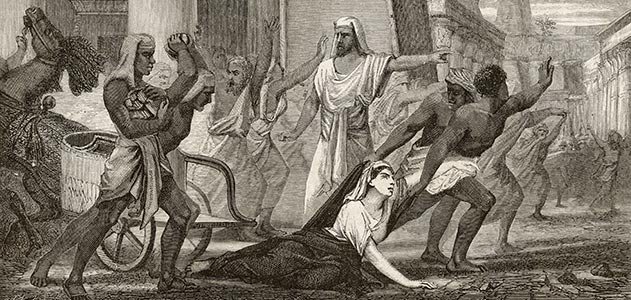
In March of 415, Peter the church lector led a mob in attacking Hypatia as she rode through the city in her chariot. Socrates Scholasticus wrote that “rash cockbrains”  dragged her into the Caesarion church, stripped her naked, and tore into her body with pot-shards, cutting her to pieces. Then they hauled her dismembered body to Cinaron and burned it on a pyre. [Alic, 45-6] John Malalas accords with Socrate’s statement that the mob burned Hypatia’s remains. Hesychius’ account agrees that the mob tore Hypatia to pieces, but simply says that “her body [was] shamefully treated and parts of it scattered all over the city.” [Dzielskaielska, 93]

In John of Nikiu’s version, men came for “the pagan woman who had beguiled the people of the city and the prefect through her enchantments.” They found her sitting in a chair and dragged her through the streets until she was dead, then burned her body.[Chronicle, 84.87-103] After Hypatia’s assassination, Orestes disappeared (fled? assassinated?). Cyril prevailed, and his parabalanoi were never punished for killing Hypatia. The bishop covered up her murder, insisting that she had moved to Athens.

No one was fooled. Our nearest contemporary sources agree that the bishop was behind the witch-rumors and the killing, and that his men carried them out. Public opinion may be measured by the fact that Christian city officials continued appealing to imperial officials to curb the parabalanoi, to bring them under secular control and restrict them from public places. They were only partially successful, since the imperial court itself was in the midst of a crackdown on pagans. As for Cyril, whom John of Nikiu credits with destroying “the last remnants of idolatry in the city,” he was later declared a saint. [Dzielskaielska,  97-8, 104. 94]

Hypatia was not targeted only as a pagan. Other pagans—men—continued to be active at the university of Alexandria for decades after her death. It is clear that Hypatia’s femaleness made her a special target, vulnerable to the accusation of witchcraft. Her courage in opposing the escalating anti-Jewish violence and her moral stance against religious repression were factors as well. In defending the assault on the philosophical tradition of tolerance, Hypatia had everything to lose, yet she acted boldly.

Later in the century, her male counterparts also came under attack. By the mid-400s, pagan professors were being sentenced to death in Syria. Some time after 480, an Alexandrian Christian society called the Zealots hounded the pagan prefect and his secretary from office and into exile. The Zealots capped their triumph with the burning of “idols.” Two of them moved on to Beirut, where they incited further hunts of leading pagans. They formed a group to collect denunciations, using informers, and brought  names and accusations to the bishop. This worthy held joint hearings with city officials, which led to more bonfires and the exile of pagans. [MacMullen, 26, 194 fn95]

The cultural repression used to Christianize the Roman empire was unprecedented anywhere up to that time, in extent, duration and geographic scale.


THE FABRICATION OF THE GALILAEANS

if-you-could-reason-with-religious-people
I have become convinced that the Pagan Mystery Schools in pre-Christian times had a firm grasp on the Truth and Nature of Reality. Those teachings were stolen and were slowly phased out to common folks, to prevent them from KNOWING that they themselves were indeed Divine Immortal Beings that contained within and without them the spark of Consciousness that has become known by the word God. No one can pass this knowledge on to others. It is an Intuitive Truth that must be personally experienced. Otherwise you will ”believe” in someone else’s experience (or someone else’s deception, as is proven by Joe Smith’s Book for Morons, Scientology by Ron L Hubbard or Christianity by Constantine. Everyone has before them the blue pill and the red pill, or in other words, a choice: however freedom is not a gift to those who prefer slavery. The following notes were for my own use and not sourced as should be for public consumption. But what the hell,  I think a lot of the material is from mountainman.com, an excellent website. I do not debate ”believers.” Belief closes the mind and takes the place of truth. One cannot argue with this kind of ignore-ance.  To worship the exoteric that passes as history is to ignore the esoteric and miss the mystical Truth and symbolic meaning that for most remain hidden in the Canonized adulterated/mutilated scriptures. Jesus is so obviously symbolic of the sun, and the sun is symbolic of the attributes of ‘god.’ To miss this is to live an entire life enslaved in a fictional reality as a fictional ego based person. (Person, from the Roman-Greek word Persona, a fictional human, masked, actor). Emperor Julian, who with first hand knowledge of what his Uncle Constantine did, wrote down only 40 years later the following:

”It is, I think, expedient to set forth to all mankind the reasons by which I was convinced that the fabrication of the Galilaeans is a fiction of men composed by wickedness. Though it has in it nothing divine, by making full use of that part of the soul which loves fable and is childish and foolish, it has induced men to believe that the monstrous tale is truth.
”It is worth while to recall in a few words whence and how we first arrived at a conception of God; next to compare what is said about the divine among the Hellenes and Hebrews; and finally to enquire of those who are neither Hellenes nor Jews, but belong to the sect of the Galilaeans, why they preferred the belief of the Jews to ours; and what, further, can be the reason why they do not even adhere to the Jewish beliefs but have abandoned them also and followed a way of their own. For they have not accepted a single admirable or important doctrine of those that are held either by us Hellenes or by the Hebrews who derived them from Moses; but from both religions they have gathered what has been engrafted like powers of evil, as it were, on these nations – atheism from the Jewish levity, and a sordid and slovenly way of living from our indolence and vulgarity; and they desire that this should be called the noblest worship of the gods.”

Flavius Claudius Julianus (331-363 CE)

Against the Galilaeans

 
It is imperative for the students of life to understand that it is only by inference that it has been believed that there were in fact christians in existence on the planet Earth prior to the fourth century. The inference that christianity existed at all in the first three centuries leans implicitly and exclusively upon the literature of Eusebius of Caesarea, as its foundational corner stone.
The literature of Eusebius is imperially sponsored literary calumny and genuinely cannot be vested with any integrity. An alternative theory of the history of antiquity considers that the prime Eusebian objective was to create as much distance as possible between the planned implementation (312-324 CE) of christianity under Constantine, and the council of Nicaea.
The very contemporary author, the first century Jewish historian Josephus had his work interpolated for this prime objective.
Constantine was going to promote this “Fabrication of the Galilaeans” as the officially supremely sanctified religion by which he was to tax, administer and otherwise obtain revenue from his newly acquired territories of the empire.
This fiction has fooled the world ever since.
Julian saw Christianity – which within a generation had ceased to be a persecuted belief and had become the official religion persecuting others – as a sickness within the body politic, and felt deep revulsion toward it from an ethical-religious viewpoint. His Uncle Constantine remained loyal to Mithraism (despite the fable of his death bed conversion). Julian’s writings reveal his knowledge of the Bible and the New Testament. He chides Christianity for having adopted the worst aspects of paganism and Judaism, and for having broken away from Judaism; he writes that the beliefs of the Jews are identical with or only slightly different from those of other nations. He compared the myths of Genesis with the Homeric epic and the Platonic cosmogony, and argued that paganism’s religious tradition and view of godhood is superior.
Everything that Julian undertook must be judged in the light of his initiation into the Eleusinian Mysteries see: https://www.rosicrucian.org/publications/digest/digest2_2009/04_web/07_keller/07_keller.pdf (and history has been at great pains to misrepresent his actions in every possible way). In order to form a true estimate of such a personality as Julian we must give due weight to the effects of this initiation. What spiritual benefit had Julian derived from his initiation into the Eleusinian Mysteries? Through direct spiritual perception he learned the secrets of cosmic and world evolution, the spiritual origin of the world and how spiritual forces operate in the planetary and solar systems. He learned to understand certain things which were quite incomprehensible to his contemporaries (with the exception of a few Greek initiates), namely, the relation of solar influences and the Being of the Sun to the old Hermes-Logos. He understood the meaning of the Pythagorean maxim: “Thou shalt not speak against the Sun!” This does not refer, of course, to the physical sun but to the Spirit which is concealed behind the Sun. He knew that the ancient sacred traditions ascribed the origin of the world to the spiritual Being of the Sun and above all that man must recover his relation to the spiritual Sun if he is to penetrate to the source of his existence.
 
(In Constantine we have a personality who had to abandon the former coercive measures practiced by the majority of the earlier emperors when they sought initiation into the Mysteries. To compensate for this he therefore did everything in his power to advance the cause of exoteric Christianity in the Empire.) He himself was a dedicated life long Pagan initiate, despite the fable of his death bed conversion.
Julian therefore was aware of the ancient Sun-Mystery. He realized that the physical sun is but the external form of a spiritual Sun which can be awakened in the soul of man through initiation, and when awakened can reveal to him the intimate connection between the universe and the historical life of man on Earth. It was clear to Julian that the world can never be ordered on a basis of rationalism, that only those who are able to be in touch with the Sun Logos are in any way fitted to have a voice in the ordering of the world. He had to recognize that the movements of the celestial bodies and the great historical movements of mankind are governed by a common law.
Remember that up to the time of Constantine, in large sections of the population the last remnants of ancient cults had been preserved. Today the question of miracles is a real thorn in the side of Biblical exegesis, because people refuse to read the Gospels from the standpoint of the age to which they, the Gospels, belong. The question of miracles raised no problems for the contemporaries of the Evangelists, for they were aware of the existence of rites and ceremonies from which men derived spiritual forces which they were able to control.
Whilst, on the one hand, Christianity was introduced as a political measure which culminated in Constantine’s edict of toleration, so attempts were made on the other hand, to suppress the ancient pagan rites. Endless laws were promulgated by Rome which forbade the celebration of rites which derived their power from the spiritual world. These laws, it is true, declared that the old superstitions must cease, that no one may practice ritual magic in order to injure others and no one may communicate with the dead, and so on, but these were only pretexts. The real purpose of these laws was to eradicate root and branch any traces of pagan cults which had survived from ancient times. Wherever possible, history has endeavored to hush up or to conceal the real facts of the situation. But our earliest historical records were the work of priests and monks in the monasteries (a fact which modern science, which claims to be “objective and to accept nothing on authority”, studiously ignores). The avowed object of the monasteries (i.e. priests and monks) was to suppress all knowledge of the true character of antiquity and to prevent the essential teachings of the pagan Mysteries from being transmitted to posterity.
Constantine inaugurated the exoteric side of Christianity and Julian the Apostate took up the struggle against the exoteric side of Christianity. It is a curious phenomenon that if anyone with a real knowledge of occult facts that can still be found in ancient writings — makes a study of Christian dogma, for example, if we inquire into the origin of the Mass, or if ritual and dogma are studied in the light of occult knowledge derived from ancient writings, we discover the most extraordinary things. What lies behind these dogmas and cult acts?Countless authors who have studied these questions have come to the conclusion that in ritual and dogma a large residuum of paganism has been preserved or has survived. An attempt was made by the French writer Drach, an authority on Hebraism, to demonstrate that the dogma and ritual of the Catholic Church were simply a revival of paganism. And others attempted to show that certain people were at pains to conceal from the faithful the fact that the dogmas and ritual of the Church were imbued with paganism.
Julian’s polemic against Christianity musters every kind of argument against Christianity, against the historical Jesus and certain Christian dogmas, with passionate sincerity. And when we compare these arguments with the objections raised by the liberal theology of the nineteenth century and the later theology of the adherents of Drews against the historicity of Christ, when we consider the whole field of literature of the eighteenth and nineteenth centuries which reveals most careful, painstaking and thorough philological investigation, there are endless repetitions, so that one has to consult whole libraries — we find that we can piece together certain guiding principles. The leading critics began to undertake a comparative study of the Gospels and found many discrepancies in the texts. But all these critical methods were already anticipated by Julian. The nineteenth-century criticism offered nothing new that was not already known to Julian. Julian spoke out of a natural creative gift whilst the nineteenth-century criticism displayed enormous industry, great erudition and downright theological sophistry.
“It was”, thought the Emperor Julian c.362 CE,”expedient to set forth to all mankind the reasons by which he was convinced that the fabrication of the Christians was a fiction of men composed by wickedness”. http://www.mountainman.com.au/essenes/thesis.pdf
The Eusebian fiction postulate may be stated thus:
Eusebius in the fourth century was sponsored by the supreme emperor Constantine to write a history for a new and strange religion that Constantine wishes to implement as a method of administration for his newly acquired empires. Manuscripts of prominent Roman and Jewish historians were perverted, false communications between non- existent bishops were fabricated, manuscripts of other writers were interpolated by Eusebius, and Eusebius uses the names of unknown writers to publish his own fictitious literature.
The entire purpose is to establish a priority date for the new and strange religion of Constantine which is as far away from the date of the Nicaean council as is possible.
The Eusebian Fiction postulate is that Constantine and Eusebius were two of the “wicked men” who composed the “fabrication of the Galilaeans” in accordance to the opinion of the Roman Emperor Julian, speaking from within 40 years of the perpetration of the fiction, at Nicaea.
The Eusebian fiction postulate is that the new and strange testament was also written by Eusebius under the sponsorship of Constantine.
The first implication of considering the historical consistency of the Eusebian fiction postulate is that there necessarily must have been another reality of antiquity, in which for the first 300 years, the tribe of christians did not physically exist.
AGAINST THE GALILAEANS
THE WORKS OF THE EMPEROR JULIAN
Letters 1 – 73

5 Reasons to Suspect Jesus Never Existed

belief--

Question EVERYTHING!” ~ George Carlin

Valerie Tarico, AlterNet

A growing number of scholars are openly questioning or actively arguing against whether Jesus lived.

Most antiquities scholars think that the New Testament gospels are “mythologized history.” In other words, they think that around the start of the first century a controversial Jewish rabbi named Yeshua ben Yosef gathered a following and his life and teachings provided the seed that grew into Christianity.

At the same time, these scholars acknowledge that many Bible stories like the virgin birth, miracles, resurrection, and women at the tomb borrow and rework mythic themes that were common in the Ancient Near East, much the way that screenwriters base new movies on old familiar tropes or plot elements. In this view, a “historical Jesus” became mythologized.

For over 200 years, a wide ranging array of theologians and historians—most of them Christian—analyzed ancient texts, both those that made it into the Bible and those that didn’t, in attempts to excavate the man behind the myth. Several current or recent bestsellers take this approach, distilling the scholarship for a popular audience. Familiar titles include Zealot by Reza Aslan and How Jesus Became God by Bart Ehrman

But other scholars believe that the gospel stories are actually “historicized mythology.” In this view, those ancient mythic templates are themselves the kernel. They got filled in with names, places and other real world details as early sects of Jesus worship attempted to understand and defend the devotional traditions they had received.

The notion that Jesus never existed is a minority position. Of course it is! says David Fitzgerald, author of Nailed: Ten Christian Myths That Show Jesus Never Existed at AllFor centuries all serious scholars of Christianity were Christians themselves, and modern secular scholars lean heavily on the groundwork that they laid in collecting, preserving, and analyzing ancient texts. Even today most secular scholars come out of a religious background, and many operate by default under historical presumptions of their former faith.

Fitzgerald is an atheist speaker and writer, popular with secular students and community groups. The internet phenom, Zeitgeist the Movie introduced millions to some of the mythic roots of Christianity. But Zeitgeist and similar works contain known errors and oversimplifications that undermine their credibility. Fitzgerald seeks to correct that by giving young people interesting, accessible information that is grounded in accountable scholarship.

More academic arguments in support of the Jesus Myth theory can be found in the writings of Richard Carrier and Robert Price. Carrier, who has a Ph.D. in ancient history uses the tools of his trade to show, among other things, how Christianity might have gotten off the ground without a miracle. Price, by contrast, writes from the perspective of a theologian whose biblical scholarship ultimately formed the basis for his skepticism. It is interesting to note that some of the harshest debunkers of fringe Jesus myth theories like those from Zeitgeist or Joseph Atwill (who tries to argue that the Romans invented Jesus) are from serious Mythicists like Fitzgerald, Carrier and Price.

The arguments on both sides of this question—mythologized history or historicized mythology—fill volumes, and if anything the debate seems to be heating up rather than resolving. A growing number of scholars are openly questioning or actively arguing against Jesus’ historicity. Since many people, both Christian and not, find it surprising that this debate even exists—that credible scholars might think Jesus never existed—here are some of the key points that keep the doubts alive:

1. No first century secular evidence whatsoever exists to support the actuality of Yeshua ben Yosef.

In the words of Bart Ehrman:

“What sorts of things do pagan authors from the time of Jesus have to say about him? Nothing. As odd as it may seem, there is no mention of Jesus at all by any of his pagan contemporaries. There are no birth records, no trial transcripts, no death certificates; there are no expressions of interest, no heated slanders, no passing references – nothing. In fact, if we broaden our field of concern to the years after his death – even if we include the entire first century of the Common Era – there is not so much as a solitary reference to Jesus in any non-Christian, non-Jewish source of any kind. I should stress that we do have a large number of documents from the time – the writings of poets, philosophers, historians, scientists, and government officials, for example, not to mention the large collection of surviving inscriptions on stone and private letters and legal documents on papyrus. In none of this vast array of surviving writings is Jesus’ name ever so much as mentioned.” (How Jesus Became God pp. 56-57)

2. The earliest New Testament writers seem ignorant of the details of Jesus’ life, which become more crystalized in later texts.

Paul seems unaware of any virgin birth, for example. No wise men, no star in the east, no miracles. Historians have long puzzled over the “Silence of Paul” on the most basic biographical facts and teachings of Jesus. Paul fails to cite Jesus’ authority precisely when it would make his case. What’s more, he never calls the twelve apostles Jesus’ disciples; in fact, he never says Jesus HAD disciples –or a ministry, or did miracles, or gave teachings. He virtually refuses to disclose any other biographical detail, and the few cryptic hints he offers aren’t just vague, but contradict the gospels. The leaders of the early Christian movement in Jerusalem like Peter and James are supposedly Jesus’ own followers and family; but Paul dismisses them as nobodies and repeatedly opposes them for not being true Christians!

Liberal theologian Marcus Borg suggests that people read the books of the New Testament in chronological order to see how early Christianity unfolded. “Placing the Gospels after Paul makes it clear that as written documents they are not the source of early Christianity but its product. The Gospel — the good news — of and about Jesus existed before the Gospels. They are the products of early Christian communities several decades after Jesus’ historical life and tell us how those communities saw his significance in their historical context.”

3. Even the New Testament stories don’t claim to be first-hand accounts.

We now know that the four gospels were assigned the names of the apostles Matthew, Mark, Luke, and John, not written by them. To make matter sketchier, the name designations happened sometime in second century, around 100 years or more after Christianity supposedly began. For a variety of reasons, the practice of pseudonymous writing was common at the time and many contemporary documents are “signed” by famous figures. The same is true of the New Testament epistles except for a handful of letters from Paul (6 out of 13) which are broadly thought to be genuine.  But even the gospel stories don’t actually say, “I was there.” Rather, they claim the existence of other witnesses, a phenomenon familiar to anyone who has heard the phrase, my aunt knew someone who . . . .

4. The gospels, our only accounts of a historical Jesus, contradict each other.

If you think you know the Jesus story pretty well, I suggest that you pause at this point to test yourself with the 20 question quiz at ExChristian.net.

The gospel of Mark is thought to be the earliest existing “life of Jesus,” and linguistic analysis suggests that Luke and Matthew both simply reworked Mark and added their own corrections and new material. But they contradict each other and, to an even greater degree contradict the much later gospel of John, because they were written with different objectives for different audiences. The incompatible Easter stories offer one example of how much the stories disagree.

5. Modern scholars who claim to have uncovered the real historical Jesus depict wildly different persons.

They include a cynic philosopher, charismatic Hasid, liberal Pharisee, conservative rabbi, Zealot revolutionary, nonviolent pacifist to borrow from a much longer list assembled by Price. In his words (pp. 15-16), “The historical Jesus (if there was one) might well have been a messianic king, or a progressive Pharisee, or a Galilean shaman, or a magus, or a Hellenistic sage.  But he cannot very well have been all of them at the same time.” John Dominic Crossan of the Jesus Seminar grumbles that “the stunning diversity is an academic embarrassment.”

For David Fitzgerald, these issues and more lead to a conclusion that he finds inescapable:

Jesus appears to be an effect, not a cause, of Christianity. Paul and the rest of the first generation of Christians searched the Septuagint translation of Hebrew scriptures to create a Mystery Faith for the Jews, complete with pagan rituals like a Lord’s Supper, Gnostic terms in his letters, and a personal savior god to rival those in their neighbors’ longstanding Egyptian, Persian, Hellenistic and Roman traditions.

In a soon-to-be-released follow up to Nailed, entitled Jesus: Mything in ActionFitzgerald argues that the many competing versions proposed by secular scholars are just as problematic as any “Jesus of Faith:” Even if one accepts that there was a real Jesus of Nazareth, the question has little practical meaning: Regardless of whether or not a first century rabbi called Yeshua ben Yosef lived, the “historical Jesus” figures so patiently excavated and re-assembled by secular scholars are themselves fictions.

We may never know for certain what put Christian history in motion. Only time (or perhaps time travel) will tell.

About the Author

Valerie Tarico is a psychologist and writer in Seattle, Washington and the founder of Wisdom Commons. She is the author of “Trusting Doubt: A Former Evangelical Looks at Old Beliefs in a New Light” and “Deas and Other Imaginings.” Her articles can be found at Awaypoint.Wordpress.com.