Extracted from Nexus Magazine
Volume 14, Number 4 (June – July 2007)
from NexusMagazine Website
|
In the fourth century, the Roman Emperor Constantine united all religious factions under one composite deity, and ordered the compilation of new and old writings into a uniform collection that became the New Testament.
.
|
What the Church doesn’t want you to know
It has often been emphasized that Christianity is unlike any other religion, for it stands or falls by certain events which are alleged to have occurred during a short period of time some 20 centuries ago. Those stories are presented in the New Testament, and as new evidence is revealed it will become clear that they do not represent historical realities.
The Church agrees, saying:
“Our documentary sources of knowledge about the origins of Christianity and its earliest development are chiefly the New Testament Scriptures, the authenticity of which we must, to a great extent, take for granted.”
(Catholic Encyclopedia, Farley ed., vol. iii, p. 712)
The Church makes extraordinary admissions about its New Testament. For example, when discussing the origin of those writings,
“the most distinguished body of academic opinion ever assembled” (Catholic Encyclopedias, Preface) admits that the Gospels “do not go back to the first century of the Christian era”
(Catholic Encyclopedia, Farley ed., vol. vi, p. 137, pp. 655-6).
This statement conflicts with priesthood assertions that the earliest Gospels were progressively written during the decades following the death of the Gospel Jesus Christ.
In a remarkable aside, the Church further admits that,
“the earliest of the extant manuscripts [of the New Testament], it is true, do not date back beyond the middle of the fourth century AD”
(Catholic Encyclopedia, op. cit., pp. 656-7).
That is some 350 years after the time the Church claims that a Jesus Christ walked the sands of Palestine, and here the true story of Christian origins slips into one of the biggest black holes in history. There is, however, a reason why there were no New Testaments until the fourth century: they were not written until then, and here we find evidence of the greatest misrepresentation of all time.
It was British-born Flavius Constantinus (Constantine, originally Custennyn or Custennin) (272-337) who authorized the compilation of the writings now called the New Testament. After the death of his father in 306, Constantine became King of Britain, Gaul and Spain, and then, after a series of victorious battles, Emperor of the Roman Empire. Christian historians give little or no hint of the turmoil of the times and suspend Constantine in the air, free of all human events happening around him. In truth, one of Constantine’s main problems was the uncontrollable disorder amongst presbyters and their belief in numerous gods.
The majority of modern-day Christian writers suppress the truth about the development of their religion and conceal Constantine’s efforts to curb the disreputable character of the presbyters who are now called “Church Fathers” (Catholic Encyclopedia, Farley ed., vol. xiv, pp. 370-1). They were “maddened”, he said (Life of Constantine, attributed to Eusebius Pamphilius of Caesarea, c. 335, vol. iii, p. 171; The Nicene and Post-Nicene Fathers, cited as N&PNF, attributed to St Ambrose, Rev. Prof. Roberts, DD, and Principal James Donaldson, LLD, editors, 1891, vol. iv, p. 467).
The “peculiar type of oratory” expounded by them was a challenge to a settled religious order (The Dictionary of Classical Mythology, Religion, Literature and Art, Oskar Seyffert, Gramercy, New York, 1995, pp. 544-5). Ancient records reveal the true nature of the presbyters, and the low regard in which they were held has been subtly suppressed by modern Church historians.
In reality, they were:
“…the most rustic fellows, teaching strange paradoxes. They openly declared that none but the ignorant was fit to hear their discourses … they never appeared in the circles of the wiser and better sort, but always took care to intrude themselves among the ignorant and uncultured, rambling around to play tricks at fairs and markets … they lard their lean books with the fat of old fables … and still the less do they understand … and they write nonsense on vellum … and still be doing, never done.”
(Contra Celsum [“Against Celsus”], Origen of Alexandria, c. 251, Bk I, p. lxvii, Bk III, p. xliv, passim)
Clusters of presbyters had developed “many gods and many lords” (1 Cor. 8:5) and numerous religious sects existed, each with differing doctrines (Gal. 1:6). Presbyterial groups clashed over attributes of their various gods and “altar was set against altar” in competing for an audience (Optatus of Milevis, 1:15, 19, early fourth century). From Constantine’s point of view, there were several factions that needed satisfying, and he set out to develop an all-embracing religion during a period of irreverent confusion. In an age of crass ignorance, with nine-tenths of the peoples of Europe illiterate, stabilizing religious splinter groups was only one of Constantine’s problems.
The smooth generalization, which so many historians are content to repeat, that Constantine “embraced the Christian religion” and subsequently granted “official toleration”, is “contrary to historical fact” and should be erased from our literature forever (Catholic Encyclopedia, Pecci ed., vol. iii, p. 299, passim). Simply put, there was no Christian religion at Constantine’s time, and the Church acknowledges that the tale of his “conversion” and “baptism” are “entirely legendary” (Catholic Encyclopedia, Farley ed., vol. xiv, pp. 370-1).
Constantine “never acquired a solid theological knowledge” and “depended heavily on his advisers in religious questions” (Catholic Encyclopedia, New Edition, vol. xii, p. 576, passim). According to Eusebeius (260-339), Constantine noted that among the presbyterian factions “strife had grown so serious, vigorous action was necessary to establish a more religious state”, but he could not bring about a settlement between rival god factions (Life of Constantine, op. cit., pp. 26-8). His advisers warned him that the presbyters’ religions were “destitute of foundation” and needed official stabilization (ibid.).
Constantine saw in this confused system of fragmented dogmas the opportunity to create a new and combined State religion, neutral in concept, and to protect it by law. When he conquered the East in 324 he sent his Spanish religious adviser, Osius of Córdoba, to Alexandria with letters to several bishops exhorting them to make peace among themselves. The mission failed and Constantine, probably at the suggestion of Osius, then issued a decree commanding all presbyters and their subordinates “be mounted on asses, mules and horses belonging to the public, and travel to the city of Nicaea” in the Roman province of Bithynia in Asia Minor.
They were instructed to bring with them the testimonies they orated to the rabble, “bound in leather” for protection during the long journey, and surrender them to Constantine upon arrival in Nicaea (The Catholic Dictionary, Addis and Arnold, 1917, “Council of Nicaea” entry).
Their writings totaled,
“in all, two thousand two hundred and thirty-one scrolls and legendary tales of gods and saviors, together with a record of the doctrines orated by them”
(Life of Constantine, op. cit., vol. ii, p. 73; N&PNF, op. cit., vol. i, p. 518).
The First Council of Nicaea and the “missing records”
Thus, the first ecclesiastical gathering in history was summoned and is today known as the Council of Nicaea. It was a bizarre event that provided many details of early clerical thinking and presents a clear picture of the intellectual climate prevailing at the time. It was at this gathering that Christianity was born, and the ramifications of decisions made at the time are difficult to calculate.
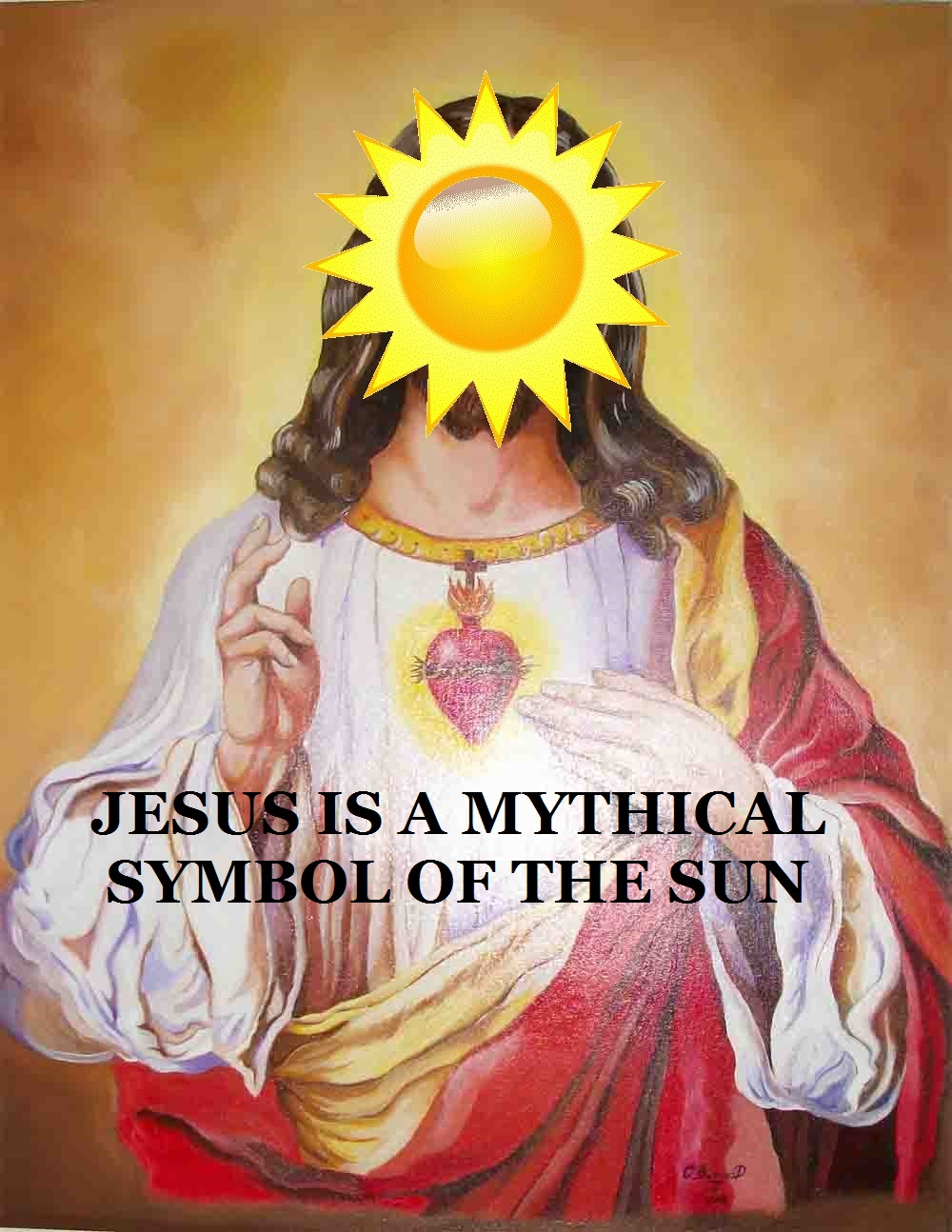
About four years prior to chairing the Council, Constantine had been initiated into the religious order of Sol Invictus, one of the two thriving cults that regarded the Sun as the one and only Supreme God (the other was Mithraism). Because of his Sun worship, he instructed Eusebius to convene the first of three sittings on the summer solstice, 21 June 325 (Catholic Encyclopedia, New Edition, vol. i, p. 792), and it was “held in a hall in Osius’s palace” (Ecclesiastical History, Bishop Louis Dupin, Paris, 1686, vol. i, p. 598).
In an account of the proceedings of the conclave of presbyters gathered at Nicaea, Sabinius, Bishop of Hereclea, who was in attendance, said,
“Excepting Constantine himself and Eusebius Pamphilius, they were a set of illiterate, simple creatures who understood nothing”
(Secrets of the Christian Fathers, Bishop J. W. Sergerus, 1685, 1897 reprint).
This is another luminous confession of the ignorance and uncritical credulity of early churchmen. Dr Richard Watson (1737-1816), a disillusioned Christian historian and one-time Bishop of Llandaff in Wales (1782), referred to them as “a set of gibbering idiots” (An Apology for Christianity, 1776, 1796 reprint; also, Theological Tracts, Dr Richard Watson, “On Councils” entry, vol. 2, London, 1786, revised reprint 1791). From his extensive research into Church councils, Dr Watson concluded that “the clergy at the Council of Nicaea were all under the power of the devil, and the convention was composed of the lowest rabble and patronized the vilest abominations” (An Apology for Christianity, op. cit.).
It was that infantile body of men who were responsible for the commencement of a new religion and the theological creation of Jesus Christ.
The Church admits that vital elements of the proceedings at Nicaea are “strangely absent from the canons” (Catholic Encyclopedia, Farley ed., vol. iii, p. 160). We shall see shortly what happened to them. However, according to records that endured, Eusebius “occupied the first seat on the right of the emperor and delivered the inaugural address on the emperor’s behalf” (Catholic Encyclopedia, Farley ed., vol. v, pp. 619-620).
There were no British presbyters at the council but many Greek delegates. “Seventy Eastern bishops” represented Asiatic factions, and small numbers came from other areas (Ecclesiastical History, ibid.). Caecilian of Carthage traveled from Africa, Paphnutius of Thebes from Egypt, Nicasius of Die (Dijon) from Gaul, and Donnus of Stridon made the journey from Pannonia.
It was at that puerile assembly, and with so many cults represented, that a total of 318 “bishops, priests, deacons, subdeacons, acolytes and exorcists” gathered to debate and decide upon a unified belief system that encompassed only one god (An Apology for Christianity, op. cit.). By this time, a huge assortment of “wild texts” (Catholic Encyclopedia, New Edition, “Gospel and Gospels”) circulated amongst presbyters and they supported a great variety of Eastern and Western gods and goddesses:
Jove, Jupiter, Salenus, Baal, Thor, Gade, Apollo, Juno, Aries, Taurus, Minerva, Rhets, Mithra, Theo, Fragapatti, Atys, Durga, Indra, Neptune, Vulcan, Kriste, Agni, Croesus, Pelides, Huit, Hermes, Thulis, Thammus, Eguptus, Iao, Aph, Saturn, Gitchens, Minos, Maximo, Hecla and Phernes
(God’s Book of Eskra, anon., ch. xlviii, paragraph 36).
Up until the First Council of Nicaea, the Roman aristocracy primarily worshipped two Greek gods -Apollo and Zeus- but the great bulk of common people idolized either Julius Caesar or Mithras (the Romanized version of the Persian deity Mithra). Caesar was deified by the Roman Senate after his death (15 March 44 BC) and subsequently venerated as “the Divine Julius”. The word “Savior” was affixed to his name, its literal meaning being “one who sows the seed”, i.e., he was a phallic god.
Julius Caesar was hailed as, “God made manifest and universal Savior of human life”, and his successor Augustus was called the “ancestral God and Savior of the whole human race”
(Man and his Gods, Homer Smith, Little, Brown & Co., Boston, 1952).
Emperor Nero (54-68), whose original name was Lucius Domitius Ahenobarbus (37-68), was immortalized on his coins as the “Savior of mankind” (ibid.). The Divine Julius as Roman Savior and “Father of the Empire” was considered “God” among the Roman rabble for more than 300 years. He was the deity in some Western presbyters’ texts, but was not recognized in Eastern or Oriental writings.
Constantine’s intention at Nicaea was to create an entirely new god for his empire who would unite all religious factions under one deity. Presbyters were asked to debate and decide who their new god would be. Delegates argued among themselves, expressing personal motives for inclusion of particular writings that promoted the finer traits of their own special deity. Throughout the meeting, howling factions were immersed in heated debates, and the names of 53 gods were tabled for discussion.
“As yet, no God had been selected by the council, and so they balloted in order to determine that matter… For one year and five months the balloting lasted…”
(God’s Book of Eskra, Prof. S. L. MacGuire’s translation, Salisbury, 1922, chapter xlviii, paragraphs 36, 41).
At the end of that time, Constantine returned to the gathering to discover that the presbyters had not agreed on a new deity but had balloted down to a shortlist of five prospects:
-
Caesar
-
Krishna
-
Mithra
-
Horus
-
Zeus
(Historia Ecclesiastica, Eusebius, c. 325).
Constantine was the ruling spirit at Nicaea and he ultimately decided upon a new god for them. To involve British factions, he ruled that the name of the great Druid god, Hesus, be joined with the Eastern Savior-god, Krishna (Krishna is Sanskrit for Christ), and thus Hesus Krishna would be the official name of the new Roman god.
A vote was taken and it was with a majority show of hands (161 votes to 157) that both divinities became one God. Following longstanding heathen custom, Constantine used the official gathering and the Roman apotheosis decree to legally deify two deities as one, and did so by democratic consent. A new god was proclaimed and “officially” ratified by Constantine (Acta Concilii Nicaeni, 1618). That purely political act of deification effectively and legally placed Hesus and Krishna among the Roman gods as one individual composite.
That abstraction lent Earthly existence to amalgamated doctrines for the Empire’s new religion; and because there was no letter “J” in alphabets until around the ninth century, the name subsequently evolved into “Jesus Christ”.
How the Gospels were created
Constantine then instructed Eusebius to organize the compilation of a uniform collection of new writings developed from primary aspects of the religious texts submitted at the council.
His instructions were:
“Search ye these books, and whatever is good in them, that retain; but whatsoever is evil, that cast away. What is good in one book, unite ye with that which is good in another book. And whatsoever is thus brought together shall be called The Book of Books. And it shall be the doctrine of my people, which I will recommend unto all nations, that there shall be no more war for religions’ sake.”
(God’s Book of Eskra, op. cit., chapter xlviii, paragraph 31)
“Make them to astonish” said Constantine, and “the books were written accordingly”
(Life of Constantine, vol. iv, pp. 36-39).
Eusebius amalgamated the “legendary tales of all the religious doctrines of the world together as one”, using the standard god-myths from the presbyters’ manuscripts as his exemplars.
Merging the supernatural “god” stories of Mithra and Krishna with British Culdean beliefs effectively joined the orations of Eastern and Western presbyters together “to form a new universal belief” (ibid.). Constantine believed that the amalgamated collection of myths would unite variant and opposing religious factions under one representative story.
Eusebius then arranged for scribes to produce,
“fifty sumptuous copies … to be written on parchment in a legible manner, and in a convenient portable form, by professional scribes thoroughly accomplished in their art”
(ibid.).
“These orders,” said Eusebius, “were followed by the immediate execution of the work itself … we sent him [Constantine] magnificently and elaborately bound volumes of three-fold and four-fold forms”
(Life of Constantine, vol. iv, p. 36).
They were the “New Testimonies”, and this is the first mention (c. 331) of the New Testament in the historical record.
With his instructions fulfilled, Constantine then decreed that the New Testimonies would thereafter be called the “word of the Roman Savior God” (Life of Constantine, vol. iii, p. 29) and official to all presbyters sermonizing in the Roman Empire. He then ordered earlier presbyterial manuscripts and the records of the council “burnt” and declared that “any man found concealing writings should be stricken off from his shoulders” (beheaded) (ibid.). As the record shows, presbyterial writings previous to the Council of Nicaea no longer exist, except for some fragments that have survived.
Some council records also survived, and they provide alarming ramifications for the Church. Some old documents say that the First Council of Nicaea ended in mid-November 326, while others say the struggle to establish a god was so fierce that it extended “for four years and seven months” from its beginning in June 325 (Secrets of the Christian Fathers, op. cit.). Regardless of when it ended, the savagery and violence it encompassed were concealed under the glossy title “Great and Holy Synod”, assigned to the assembly by the Church in the 18th century.
Earlier Churchmen, however, expressed a different opinion.
The Second Council of Nicaea in 786-87 denounced the First Council of Nicaea as,
“a synod of fools and madmen” and sought to annul “decisions passed by men with troubled brains”
(History of the Christian Church, H. H. Milman, DD, 1871).
If one chooses to read the records of the Second Nicaean Council and notes references to “affrighted bishops” and the “soldiery” needed to “quell proceedings”, the “fools and madmen” declaration is surely an example of the pot calling the kettle black.
Constantine died in 337 and his outgrowth of many now-called pagan beliefs into a new religious system brought many converts. Later Church writers made him “the great champion of Christianity” which he gave,
“legal status as the religion of the Roman Empire”
(Encyclopedia of the Roman Empire, Matthew Bunson, Facts on File, New York, 1994, p. 86).
Historical records reveal this to be incorrect, for it was “self-interest” that led him to create Christianity (A Smaller Classical Dictionary, J. M. Dent, London, 1910, p. 161). Yet it wasn’t called “Christianity” until the 15th century (How The Great Pan Died, Professor Edmond S. Bordeaux [Vatican archivist], Mille Meditations, USA, MCMLXVIII, pp. 45-7).
Over the ensuing centuries, Constantine’s New Testimonies were expanded upon, “interpolations” were added and other writings included (Catholic Encyclopedia, Farley ed., vol. vi, pp. 135-137; also, Pecci ed., vol. ii, pp. 121-122). For example, in 397 John “golden-mouthed” Chrysostom restructured the writings of Apollonius of Tyana, a first-century wandering sage, and made them part of the New Testimonies (Secrets of the Christian Fathers, op. cit.).
The Latinized name for Apollonius is Paulus (A Latin-English Dictionary, J. T. White and J. E. Riddle, Ginn & Heath, Boston, 1880), and the Church today calls those writings the Epistles of Paul. Apollonius’s personal attendant, Damis, an Assyrian scribe, is Demis in the New Testament (2 Tim. 4:10).
The Church hierarchy knows the truth about the origin of its Epistles, for Cardinal Bembo (d. 1547), secretary to Pope Leo X (d. 1521), advised his associate, Cardinal Sadoleto, to disregard them, saying,
“put away these trifles, for such absurdities do not become a man of dignity; they were introduced on the scene later by a sly voice from heaven”
(Cardinal Bembo: His Letters and Comments on Pope Leo X, A. L. Collins, London, 1842 reprint).
The Church admits that the Epistles of Paul are forgeries, saying,
“Even the genuine Epistles were greatly interpolated to lend weight to the personal views of their authors”
(Catholic Encyclopedia, Farley ed., vol. vii, p. 645).
Likewise, St Jerome (d. 420) declared that the Acts of the Apostles, the fifth book of the New Testament, was also “falsely written” (“The Letters of Jerome”, Library of the Fathers, Oxford Movement, 1833-45, vol. v, p. 445).
The shock discovery of an ancient Bible
The New Testament subsequently evolved into a fulsome piece of priesthood propaganda, and the Church claimed it recorded the intervention of a divine Jesus Christ into Earthly affairs. However, a spectacular discovery in a remote Egyptian monastery revealed to the world the extent of later falsifications of the Christian texts, themselves only an “assemblage of legendary tales” (Encyclopédie, Diderot, 1759).
On 4 February 1859, 346 leaves of an ancient codex were discovered in the furnace room at St Catherine’s monastery at Mt Sinai, and its contents sent shockwaves through the Christian world. Along with other old codices, it was scheduled to be burned in the kilns to provide winter warmth for the inhabitants of the monastery. Written in Greek on donkey skins, it carried both the Old and New Testaments, and later in time archaeologists dated its composition to around the year 380.
It was discovered by Dr Constantin von Tischendorf (1815-1874), a brilliant and pious German biblical scholar, and he called it the Sinaiticus, the Sinai Bible. Tischendorf was a professor of theology who devoted his entire life to the study of New Testament origins, and his desire to read all the ancient Christian texts led him on the long, camel-mounted journey to St Catherine’s Monastery.
During his lifetime, Tischendorf had access to other ancient Bibles unavailable to the public, such as the Alexandrian (or Alexandrinus) Bible, believed to be the second oldest Bible in the world. It was so named because in 1627 it was taken from Alexandria to Britain and gifted to King Charles I (1600-49). Today it is displayed alongside the world’s oldest known Bible, the Sinaiticus, in the British Library in London. During his research, Tischendorf had access to the Vaticanus, the Vatican Bible, believed to be the third oldest in the world and dated to the mid-sixth century (The Various Versions of the Bible, Dr Constantin von Tischendorf, 1874, available in the British Library).
It was locked away in the Vatican’s inner library. Tischendorf asked if he could extract handwritten notes, but his request was declined. However, when his guard took refreshment breaks, Tischendorf wrote comparative narratives on the palm of his hand and sometimes on his fingernails (“Are Our Gospels Genuine or Not?”, Dr Constantin von Tischendorf, lecture, 1869, available in the British Library).
Today, there are several other Bibles written in various languages during the fifth and sixth centuries, examples being the Syriacus, the Cantabrigiensis (Bezae), the Sarravianus and the Marchalianus.
A shudder of apprehension echoed through Christendom in the last quarter of the 19th century when English-language versions of the Sinai Bible were published. Recorded within these pages is information that disputes Christianity’s claim of historicity. Christians were provided with irrefutable evidence of willful falsifications in all modern New Testaments. So different was the Sinai Bible’s New Testament from versions then being published that the Church angrily tried to annul the dramatic new evidence that challenged its very existence.
In a series of articles published in the London Quarterly Review in 1883, John W. Burgon, Dean of Chichester, used every rhetorical device at his disposal to attack the Sinaiticus’ earlier and opposing story of Jesus Christ, saying that,
“…without a particle of hesitation, the Sinaiticus is scandalously corrupt … exhibiting the most shamefully mutilated texts which are anywhere to be met with; they have become, by whatever process, the depositories of the largest amount of fabricated readings, ancient blunders and intentional perversions of the truth which are discoverable in any known copies of the word of God”.
Dean Burgon’s concerns mirror opposing aspects of Gospel stories then current, having by now evolved to a new stage through centuries of tampering with the fabric of an already unhistorical document.
The revelations of ultraviolet light testing
In 1933, the British Museum in London purchased the Sinai Bible from the Soviet government for £100,000, of which £65,000 was gifted by public subscription. Prior to the acquisition, this Bible was displayed in the Imperial Library in St Petersburg, Russia, and “few scholars had set eyes on it” (The Daily Telegraph and Morning Post, 11 January 1938, p. 3). When it went on display in 1933 as “the oldest Bible in the world” (ibid.), it became the centre of a pilgrimage unequalled in the history of the British Museum.
Before I summarize its conflictions, it should be noted that this old codex is by no means a reliable guide to New Testament study as it contains superabundant errors and serious re-editing. These anomalies were exposed as a result of the months of ultraviolet-light tests carried out at the British Museum in the mid-1930s. The findings revealed replacements of numerous passages by at least nine different editors.
Photographs taken during testing revealed that ink pigments had been retained deep in the pores of the skin. The original words were readable under ultraviolet light. Anybody wishing to read the results of the tests should refer to the book written by the researchers who did the analysis: the Keepers of the Department of Manuscripts at the British Museum (Scribes and Correctors of the Codex Sinaiticus, H. J. M. Milne and T. C. Skeat, British Museum, London, 1938).
Forgery in the Gospels
When the New Testament in the Sinai Bible is compared with a modern-day New Testament, a staggering 14,800 editorial alterations can be identified. These amendments can be recognized by a simple comparative exercise that anybody can and should do. Serious study of Christian origins must emanate from the Sinai Bible’s version of the New Testament, not modern editions.
Of importance is the fact that the Sinaiticus carries three Gospels since rejected:
-
the Shepherd of Hermas (written by two resurrected ghosts, Charinus and Lenthius)
-
the Missive of Barnabas
-
the Odes of Solomon
Space excludes elaboration on these bizarre writings and also discussion on dilemmas associated with translation variations.
Modern Bibles are five removes in translation from early editions, and disputes rage between translators over variant interpretations of more than 5,000 ancient words. However, it is what is not written in that old Bible that embarrasses the Church, and this article discusses only a few of those omissions.
One glaring example is subtly revealed in the Encyclopaedia Biblica (Adam & Charles Black, London, 1899, vol. iii, p. 3344), where the Church divulges its knowledge about exclusions in old Bibles, saying:
“The remark has long ago and often been made that, like Paul, even the earliest Gospels knew nothing of the miraculous birth of our Saviour”.
That is because there never was a virgin birth.
It is apparent that when Eusebius assembled scribes to write the New Testimonies, he first produced a single document that provided an exemplar or master version. Today it is called the Gospel of Mark, and the Church admits that it was “the first Gospel written” (Catholic Encyclopedia, Farley ed., vol. vi, p. 657), even though it appears second in the New Testament today. The scribes of the Gospels of Matthew and Luke were dependent upon the Mark writing as the source and framework for the compilation of their works. The Gospel of John is independent of those writings, and the late-15th-century theory that it was written later to support the earlier writings is the truth (The Crucifixion of Truth, Tony Bushby, Joshua Books, 2004, pp. 33-40).
Thus, the Gospel of Mark in the Sinai Bible carries the “first” story of Jesus Christ in history, one completely different to what is in modern Bibles. It starts with Jesus “at about the age of thirty” (Mark 1:9), and doesn’t know of Mary, a virgin birth or mass murders of baby boys by Herod. Words describing Jesus Christ as “the son of God” do not appear in the opening narrative as they do in today’s editions (Mark 1:1), and the modern-day family tree tracing a “messianic bloodline” back to King David is non-existent in all ancient Bibles, as are the now-called “messianic prophecies” (51 in total).
The Sinai Bible carries a conflicting version of events surrounding the “raising of Lazarus”, and reveals an extraordinary omission that later became the central doctrine of the Christian faith: the resurrection appearances of Jesus Christ and his ascension into Heaven. No supernatural appearance of a resurrected Jesus Christ is recorded in any ancient Gospels of Mark, but a description of over 500 words now appears in modern Bibles (Mark 16:9-20).
Despite a multitude of long-drawn-out self-justifications by Church apologists, there is no unanimity of Christian opinion regarding the non-existence of “resurrection” appearances in ancient Gospel accounts of the story. Not only are those narratives missing in the Sinai Bible, but they are absent in the Alexandrian Bible, the Vatican Bible, the Bezae Bible and an ancient Latin manuscript of Mark, code-named “K” by analysts. They are also lacking in the oldest Armenian version of the New Testament, in sixth-century manuscripts of the Ethiopic version and ninth-century Anglo-Saxon Bibles. However, some 12th-century Gospels have the now-known resurrection verses written within asterisks-marks used by scribes to indicate spurious passages in a literary document.
The Church claims that “the resurrection is the fundamental argument for our Christian belief” (Catholic Encyclopedia, Farley ed., vol. xii, p. 792), yet no supernatural appearance of a resurrected Jesus Christ is recorded in any of the earliest Gospels of Mark available. A resurrection and ascension of Jesus Christ is the sine qua non (“without which, nothing”) of Christianity (Catholic Encyclopedia, Farley ed., vol. xii, p. 792), confirmed by words attributed to Paul:
“If Christ has not been raised, your faith is in vain”
(1 Cor. 5:17).
The resurrection verses in today’s Gospels of Mark are universally acknowledged as forgeries and the Church agrees, saying,
“the conclusion of Mark is admittedly not genuine … almost the entire section is a later compilation”
(Encyclopaedia Biblica, vol. ii, p. 1880, vol. iii, pp. 1767, 1781; also, Catholic Encyclopedia, vol. iii, under the heading “The Evidence of its Spuriousness”; Catholic Encyclopedia, Farley ed., vol. iii, pp. 274-9 under heading “Canons”).
Undaunted, however, the Church accepted the forgery into its dogma and made it the basis of Christianity.
The trend of fictitious resurrection narratives continues. The final chapter of the Gospel of John (21) is a sixth-century forgery, one entirely devoted to describing Jesus‘ resurrection to his disciples.
The Church admits:
“The sole conclusion that can be deduced from this is that the 21st chapter was afterwards added and is therefore to be regarded as an appendix to the Gospel”
(Catholic Encyclopedia, Farley ed., vol. viii, pp. 441-442; New Catholic Encyclopedia (NCE), “Gospel of John”, p. 1080; also NCE, vol. xii, p. 407).
“The Great Insertion” and “The Great Omission”
Modern-day versions of the Gospel of Luke have a staggering 10,000 more words than the same Gospel in the Sinai Bible. Six of those words say of Jesus “and was carried up into heaven”, but this narrative does not appear in any of the oldest Gospels of Luke available today (“Three Early Doctrinal Modifications of the Text of the Gospels“, F. C. Conybeare, The Hibbert Journal, London, vol. 1, no. 1, Oct 1902, pp. 96-113). Ancient versions do not verify modern-day accounts of an ascension of Jesus Christ, and this falsification clearly indicates an intention to deceive.
Today, the Gospel of Luke is the longest of the canonical Gospels because it now includes “The Great Insertion”, an extraordinary 15th-century addition totaling around 8,500 words (Luke 9:51-18:14). The insertion of these forgeries into that Gospel bewilders modern Christian analysts, and of them the Church said:
“The character of these passages makes it dangerous to draw inferences”
(Catholic Encyclopedia, Pecci ed., vol. ii, p. 407).
Just as remarkable, the oldest Gospels of Luke omit all verses from 6:45 to 8:26, known in priesthood circles as “The Great Omission”, a total of 1,547 words. In today’s versions, that hole has been “plugged up” with passages plagiarized from other Gospels. Dr Tischendorf found that three paragraphs in newer versions of the Gospel of Luke’s version of the Last Supper appeared in the 15th century, but the Church still passes its Gospels off as the unadulterated “word of God” (“Are Our Gospels Genuine or Not?”, op. cit.)
The “Expurgatory Index”
As was the case with the New Testament, so also were damaging writings of early “Church Fathers” modified in centuries of copying, and many of their records were intentionally rewritten or suppressed.
Adopting the decrees of the Council of Trent (1545-63), the Church subsequently extended the process of erasure and ordered the preparation of a special list of specific information to be expunged from early Christian writings (Delineation of Roman Catholicism, Rev. Charles Elliott, DD, G. Lane & P. P. Sandford, New York, 1842, p. 89; also, The Vatican Censors, Professor Peter Elmsley, Oxford, p. 327, pub. date n/a).
In 1562, the Vatican established a special censoring office called Index Expurgatorius. Its purpose was to prohibit publication of “erroneous passages of the early Church Fathers” that carried statements opposing modern-day doctrine.
When Vatican archivists came across,
“genuine copies of the Fathers, they corrected them according to the Expurgatory Index”
(Index Expurgatorius Vaticanus, R. Gibbings, ed., Dublin, 1837; The Literary Policy of the Church of Rome, Joseph Mendham, J. Duncan, London, 1830, 2nd ed., 1840; The Vatican Censors, op. cit., p. 328).
This Church record provides researchers with,
“grave doubts about the value of all patristic writings released to the public”
(The Propaganda Press of Rome, Sir James W. L. Claxton, Whitehaven Books, London, 1942, p. 182).
Important for our story is the fact that the Encyclopaedia Biblica reveals that around 1,200 years of Christian history are unknown: “Unfortunately, only few of the records [of the Church] prior to the year 1198 have been released”. It was not by chance that, in that same year (1198), Pope Innocent III (1198-1216) suppressed all records of earlier Church history by establishing the Secret Archives (Catholic Encyclopedia, Farley ed., vol. xv, p. 287). Some seven-and-a-half centuries later, and after spending some years in those Archives, Professor Edmond S. Bordeaux wrote How The Great Pan Died.
In a chapter titled “The Whole of Church History is Nothing but a Retroactive Fabrication“, he said this (in part):
“The Church ante-dated all her late works, some newly made, some revised and some counterfeited, which contained the final expression of her history … her technique was to make it appear that much later works written by Church writers were composed a long time earlier, so that they might become evidence of the first, second or third centuries.”
(How The Great Pan Died, op. cit., p. 46)
Supporting Professor Bordeaux’s findings is the fact that, in 1587, Pope Sixtus V (1585-90) established an official Vatican publishing division and said in his own words,
“Church history will be now be established … we shall seek to print our own account”
(Encyclopédie, Diderot, 1759).
Vatican records also reveal that Sixtus V spent 18 months of his life as pope personally writing a new Bible and then introduced into Catholicism a “New Learning” (Catholic Encyclopedia, Farley ed., vol. v, p. 442, vol. xv, p. 376). The evidence that the Church wrote its own history is found in Diderot’s Encyclopédie, and it reveals the reason why Pope Clement XIII (1758-69) ordered all volumes to be destroyed immediately after publication in 1759.
Gospel authors exposed as imposters
There is something else involved in this scenario and it is recorded in the Catholic Encyclopedia. An appreciation of the clerical mindset arises when the Church itself admits that it does not know who wrote its Gospels and Epistles, confessing that all 27 New Testament writings began life anonymously:
“It thus appears that the present titles of the Gospels are not traceable to the evangelists themselves … they [the New Testament collection] are supplied with titles which, however ancient, do not go back to the respective authors of those writings.”
(Catholic Encyclopedia, Farley ed., vol. vi, pp. 655-6)
The Church maintains that “the titles of our Gospels were not intended to indicate authorship”, adding that “the headings … were affixed to them” (Catholic Encyclopedia, Farley ed., vol. i, p. 117, vol. vi, pp. 655, 656). Therefore they are not Gospels written “according to Matthew, Mark, Luke or John”, as publicly stated. The full force of this confession reveals that there are no genuine apostolic Gospels, and that the Church’s shadowy writings today embody the very ground and pillar of Christian foundations and faith.
The consequences are fatal to the pretence of Divine origin of the entire New Testament and expose Christian texts as having no special authority. For centuries, fabricated Gospels bore Church certification of authenticity now confessed to be false, and this provides evidence that Christian writings are wholly fallacious.
After years of dedicated New Testament research, Dr Tischendorf expressed dismay at the differences between the oldest and newest Gospels, and had trouble understanding…
“…how scribes could allow themselves to bring in here and there changes which were not simply verbal ones, but such as materially affected the very meaning and, what is worse still, did not shrink from cutting out a passage or inserting one.”
(Alterations to the Sinai Bible, Dr Constantin von Tischendorf, 1863, available in the British Library, London)
After years of validating the fabricated nature of the New Testament, a disillusioned Dr Tischendorf confessed that modern-day editions have “been altered in many places” and are “not to be accepted as true” (When Were Our Gospels Written?, Dr Constantin von Tischendorf, 1865, British Library, London).
Just what is Christianity?
The important question then to ask is this: if the New Testament is not historical, what is it?
Dr Tischendorf provided part of the answer when he said in his 15,000 pages of critical notes on the Sinai Bible that,
“it seems that the personage of Jesus Christ was made narrator for many religions”.
This explains how narratives from the ancient Indian epic, the Mahabharata, appear verbatim in the Gospels today (e.g., Matt. 1:25, 2:11, 8:1-4, 9:1-8, 9:18-26), and why passages from the Phenomena of the Greek statesman Aratus of Sicyon (271-213 BC) are in the New Testament.
Extracts from the Hymn to Zeus, written by Greek philosopher Cleanthes (c. 331-232 BC), are also found in the Gospels, as are 207 words from the Thais of Menander (c. 343-291), one of the “seven wise men” of Greece. Quotes from the semi-legendary Greek poet Epimenides (7th or 6th century BC) are applied to the lips of Jesus Christ, and seven passages from the curious Ode of Jupiter (c. 150 BC; author unknown) are reprinted in the New Testament.
Tischendorf‘s conclusion also supports Professor Bordeaux‘s Vatican findings that reveal the allegory of Jesus Christ derived from the fable of Mithra, the divine son of God (Ahura Mazda) and messiah of the first kings of the Persian Empire around 400 BC. His birth in a grotto was attended by magi who followed a star from the East. They brought “gifts of gold, frankincense and myrrh” (as in Matt. 2:11) and the newborn baby was adored by shepherds. He came into the world wearing the Mithraic cap, which popes imitated in various designs until well into the 15th century.
Mithra, one of a trinity, stood on a rock, the emblem of the foundation of his religion, and was anointed with honey. After a last supper with Helios and 11 other companions, Mithra was crucified on a cross, bound in linen, placed in a rock tomb and rose on the third day or around 25 March (the full moon at the spring equinox, a time now called Easter after the Babylonian goddess Ishtar). The fiery destruction of the universe was a major doctrine of Mithraism – a time in which Mithra promised to return in person to Earth and save deserving souls. Devotees of Mithra partook in a sacred communion banquet of bread and wine, a ceremony that paralleled the Christian Eucharist and preceded it by more than four centuries.
Christianity is an adaptation of,
-
Mithraism welded with the Druidic principles of the Culdees
-
some Egyptian elements (the pre-Christian Book of Revelation was originally called The Mysteries of Osiris and Isis)
-
Greek philosophy
-
various aspects of Hinduism
Why there are no records of Jesus Christ
It is not possible to find in any legitimate religious or historical writings compiled between the beginning of the first century and well into the fourth century any reference to Jesus Christ and the spectacular events that the Church says accompanied his life.
This confirmation comes from Frederic Farrar (1831-1903) of Trinity College, Cambridge:
“It is amazing that history has not embalmed for us even one certain or definite saying or circumstance in the life of the Saviour of mankind … there is no statement in all history that says anyone saw Jesus or talked with him. Nothing in history is more astonishing than the silence of contemporary writers about events relayed in the four Gospels.”
(The Life of Christ, Frederic W. Farrar, Cassell, London, 1874)
This situation arises from a conflict between history and New Testament narratives. Dr Tischendorf made this comment:
“We must frankly admit that we have no source of information with respect to the life of Jesus Christ other than ecclesiastic writings assembled during the fourth century.”
(Codex Sinaiticus, Dr Constantin von Tischendorf, British Library, London)
There is an explanation for those hundreds of years of silence:
the construct of Christianity did not begin until after the first quarter of the fourth century, and that is why Pope Leo X (d. 1521) called Christ a “fable”
(Cardinal Bembo: His Letters…, op. cit.).

About the Author
Tony Bushby, an Australian, became a businessman and entrepreneur early in his adult life. He established a magazine-publishing business and spent 20 years researching, writing and publishing his own magazines, primarily for the Australian and New Zealand markets.
With strong spiritual beliefs and an interest in metaphysical subjects, Tony has developed long relationships with many associations and societies throughout the world that have assisted his research by making their archives available. He is the author of The Bible Fraud (2001; reviewed in NEXUS 8/06 with extracts in NEXUS 9/01—03), The Secret in the Bible (2003; reviewed in 11/02, with extract, “Ancient Cities under the Sands of Giza”, in 11/03) and The Crucifixion of Truth (2005; reviewed in 12/02) and The Twin Deception (2007; reviewed 14/03).
Copies of these books are available from the NEXUS website and the Joshua Books website http://www.joshuabooks.com
As Tony Bushby vigorously protects his privacy, any correspondence should be sent to him care of NEXUS Magazine, PO Box 30, Mapleton Qld 4560, Australia, fax +61 (0) 7 5442 9381.
via The Forged Origins of The New Testament.
 When you find religion, you find money as these two tenets in life are married to one another. Within these two entities, you’ll also find their bastard stepchild, government as all 3 are perpetually tied to each other.
 you ever felt good after watching the news? If you trace who owns the mainstream media in the United States (TV, newspapers, radio stations, magazines, etc…) you’ll find that there are only 6 people at the top of the chain and all have Zionist ties, so what are the chances that your news is “fair and unbiased”?
 hipmonkey