Horus

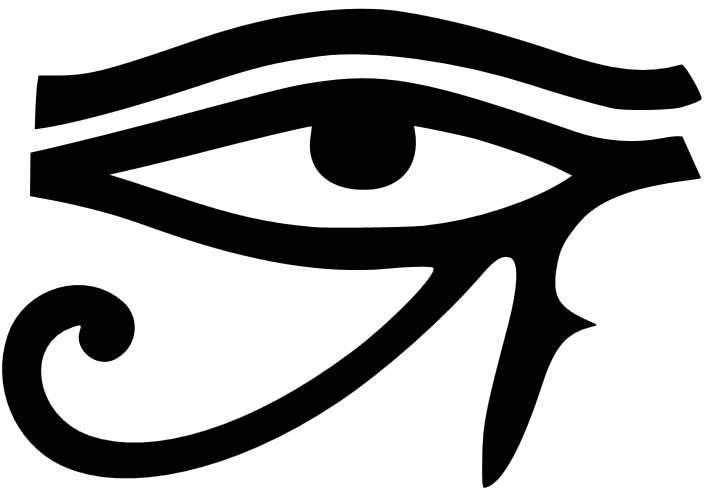
Eye_of_Horus


Horus was known by many names such as The Truth, The Light, God’s Anointed Son, The Good Shepherd, The Lamb of God, and many others.

“Horus was born on December 25th”

The December 25th, the winter-solstice, birth of the sun god is a common theme in many cultures around the world over the past millennia.

“Horus was born of a virgin”

The Egyptian Goddess was the Great Virgin (hwnt) the Mother of the God, and was the object of the very same praise bestowed upon her successor Mary, Virgin Mother of Jesus. – Bonn Dr. G. Johannes Botterweck

“Three Wise Men Came to Adore the New Born Savior”

Three Kings:  Three Kings are the stars in Orion‘s belt: They are anmed “Mintaka, Anilam and Alnitak.”

”At the age of 12, he was a prodigal child teacher, and at the age of 30 he was baptized by a figure known as Anup and thus began his ministry.”

The age of 12 refers to the sun at high noon, the twelfth hour of the day, when the God Sun is doing his heavenly father‘s work.

Concerning the sun god‘s nightly journey back to life, Egyptologist Dr. Jacobus Van Dijk of the University of Groningen says that ―according to the Pyramid Texts, the sun god purifies himself in the morning in the Lake of the Field of Rushes. Thus, the morning sun—or Horus—was said to pass through the purifying or baptismal waters to become reborn, revivified or resurrected.

”Horus had 12 disciples he traveled about with, performing miracles such as healing the sick and walking on water.”

Horus is thus firmly associated with 12 star gods, who, in conducting the sun god through his passage, can be deemed his ―protectors, assistants or helpers.

…in the tenth hour of the Amduat, Horus the Elder leaning on his staff is depicted as leading the 12 “drowned” or lost souls to their salvation in the “Fields of the Blessed.” These 12 deceased, Hornung relates, are “saved from decay and decomposition by Horus, who leads them to a blessed posthumous existence…” In this manner, Horus’s companions, like the disciples of Jesus, are meant to “become like gods,” so to speak, and to exist forever, reaping eternal life, as do those who believe in Christ.

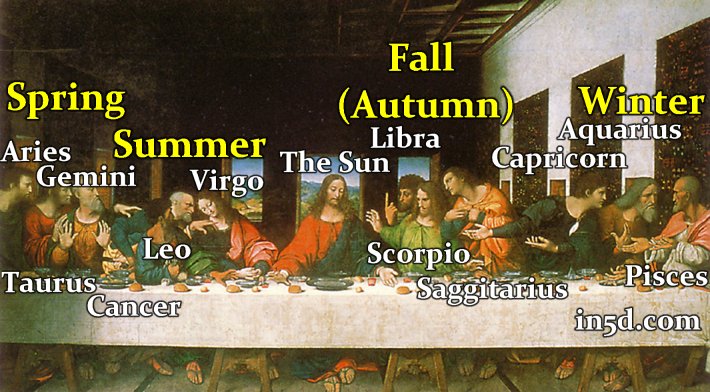
Now, probably the most obvious of all the astrological symbolism around Jesus regards the 12 disciples. They are simply the 12 constellations of the Zodiac, which Jesus, being the Sun, travels about with. In fact, the number 12 is replete throughout the Bible.

Biblical examples:
The 12 Princes of Ishmael (Gen 17:20)
The 12 Sons of Jacob (Gen 35:22)
The 12 Tribes of Israel (Gen 49:28)
The 12 Prophets and Kings of Israel
The 12 Wells of Water (Exd 15:27)
The 12 Pillars of the Lord (Exd 24:4)
The 12 Stones of the Breastplate (Exd 39:14)
The 12 Cakes of the Tabernacle (Lev 24:5)
The 12 Princes of Israel (Num 1:44)
The 12 Oxen of the Tabernacle (Num 7:3)
The 12 Chargers of Silver, Bowls of Silver and Spoons of Gold (Num 7:84)
The 12 Bullocks, Rams, Lambs and Kids of the Offering (Num 7:87)
The 12 Rods of the Princes of Israel (Num 17:6) The 12 Stones of Joshua (Jos 4:8)
The 12 Cities (Jos 18:24, 19:25, 21:7, 21:40)
The 12 Judges of Israel (Jdg 3, 4, 6, 10, 12, 13)
The 12 Pieces of the Concubine (Jdg 19:29)
The 12 Servants of David (2 Sa 2:15)
The 12 Officers of Solomon (1 Ki 4:7) The 12 Lions of Solomon (1 Ki 10:20)
The 12 Pieces of Jeroboam‘s Garment (1 Ki 11:30)
The 12 Stones of Elijah (1 Ki 18:31)
The 12 Bronze Bulls of Solomon (Jer 52:20)
The 12 Disciples/Apostles of Jesus (Mt 10:1-2)
The 12 Baskets of Bread (Mt 14:20)
The 12 Thrones in Heaven (Mt 19:28)
The 12 Legions of Angels (Mt 26:53)
The 12 Patriarchs of Israel (Acts 7:8)
The 12 Stars of the Woman‘s Crown (Rev 12:1)
The 12 Gates, Angels and Pearls of Holy Jerusalem (Rev 21:12, 21)
The 12 Fruits of the Tree of Life (Rev 22:2)

“After being “betrayed” by Typhon, Horus was “crucified,” buried for three days, and thus, resurrected.”

This symbolic imagery of a person on a cross or in cross-shape was fairly common in the Pagan world, concerning many gods, goddesses and other figures.

These pre-Christian or non-Christian gods on a cross were what was being discussed around 150 AD/CE by Church father Justin Martyr (First Apology, 21):
”And when we say also that the Word, who is the first-birth of God, was produced without sexual union, and that He, Jesus Christ, our Teacher, was crucified and died, and rose again, and ascended into heaven, we propound nothing different from what you believe regarding those whom you esteem sons of Jupiter.”

Catholic scholar Dr. Botterweck states:
”…In a sun myth the sun is swallowed up by the western part of the sea and then rises again. This myth is “historicized and re-neutralized in Jonah, as…Jonah replaces the sun and the ‘great fish’ plays the role of the sea.” On the other hand, the period of time Jonah stayed in the belly of the fish suggests a moon myth, and calls to mind, among other things, Inanna’s descent into the underworld…”

As Horus who manifests himself in the sun goes to rest in the evening and awakes from the sleep of death in the morning, so do death and resurrection seem to be equally inevitable and natural.

From the ancient hieroglyphics in Egypt, we know much about this solar messiah. For instance, Horus, being the sun, or the light, had an enemy known as Set, and Set was the personification of the darkness or night (sunSet). And, metaphorically speaking, every morning Horus would win the battle against Set—while in the evening, Set would conquer Horus and send him into the underworld. It is important to note that “dark vs. light” or “good vs. evil” is one of the most ubiquitous mythological dualities ever known and is still expressed on many levels to this day. Egyptologist Dr. Jan Assman

The sun, with its life-giving and saving qualities was personified as a representative of the unseen creator or god — “God’s Sun”

The sun was NEVER worshipped as a material ball of fire in the sky by any Pagan, ever. It was seen as symbolically having the attributes of the unknowable God/Creator/Us or whatever you want to call the un-namable. Ha! Wow. Well, it cannot be named! The story of the sun has always been personified, and there are numerous sun-gods in history. Jesus is just one of many, and the others came BEFORE him. Jesus is the greatest story ever sold, and without Roman influenced dogma everyone would see how beautiful and meaningful the jesus myth was meant to be.

Horus lives on even today. We’re always aware of the time, but not that ‘hours’ comes directly from the name Horus. Horizon is also from the name Horus. How did all these over 20 early man-god sun figures become known as mythical but the last myth,  created from the others,  is literally true? God is in everything, and everything is in God. It’s an energy without substance and it’s in me/you. I am that I am. We are.

Beyond Left & Right: Escaping the Matrix

WIKI-Matrix-01

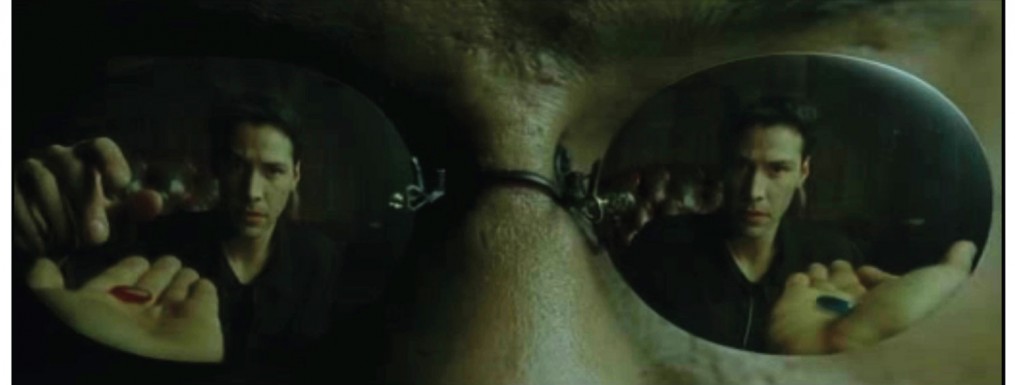
The defining dramatic moment in the film The Matrix occurs just after Morpheus invites Neo to choose between a red pill and a blue pill. The red pill promises “the truth, nothing more.” Neo takes the red pill and awakes to reality – something utterly different from anything Neo, or the audience, could have expected. What Neo had assumed to be reality turned out to be only a collective illusion, fabricated by the Matrix and fed to a population that is asleep, cocooned in grotesque embryonic pods. In Plato’s famous parable about the shadows on the walls of the cave, true reality is at least reflected in perceived reality. In the Matrix world, true reality and perceived reality exist on entirely different planes.

The story is intended as metaphor, and the parallels that drew my attention had to do with political reality. This article offers a particular perspective on what’s going on in the world – and how things got to be that way – in this era of globalization. From that red-pill perspective, everyday media-consensus reality – like the Matrix in the film – is seen to be a fabricated collective illusion. Like Neo, I didn’t know what I was looking for when my investigation began, but I knew that what I was being told didn’t make sense. I read scores of histories and biographies, observing connections between them, and began to develop my own theories about roots of various historical events. I found myself largely in agreement with writers like Noam Chomsky and Michael Parenti, but I also perceived important patterns that others seem to have missed.

When I started tracing historical forces, and began to interpret present-day events from a historical perspective, I could see the same old dynamics at work and found a meaning in unfolding events far different from what official pronouncements proclaimed. Such pronouncements are, after all, public relations fare, given out by politicians who want to look good to the voters. Most of us expect rhetoric from politicians, and take what they say with a grain of salt. But as my own picture of present reality came into focus, “grain of salt” no longer worked as a metaphor. I began to see that consensus reality – as generated by official rhetoric and amplified by mass media – bears very little relationship to actual reality. “The matrix” was a metaphor I was ready for.

In consensus reality (the blue-pill perspective) “left” and “right” are the two ends of the political spectrum. Politics is a tug-of-war between competing factions, carried out by political parties and elected representatives. Society gets pulled this way and that within the political spectrum, reflecting the interests of whichever party won the last election. The left and right are therefore political enemies. Each side is convinced that it knows how to make society better; each believes the other enjoys undue influence; and each blames the other for the political stalemate that apparently prevents society from dealing effectively with its problems.This perspective on the political process, and on the roles of left and right, is very far from reality. It is a fabricated collective illusion. Morpheus tells Neo that the Matrix is “the world that was pulled over your eyes to hide you from the truth…. As long as the Matrix exists, humanity cannot be free.” Consensus political reality is precisely such a matrix. Later we will take a fresh look at the role of left and right, and at national politics. But first we must develop our red-pill historical perspective. I’ve had to condense the arguments to bare essentials; please see the annotated sources at the end for more thorough treatments of particular topics.

Imperialism and the Matrix

From the time of Columbus to 1945, world affairs were largely dominated by competition among Western nations seeking to stake out spheres of influence, control sea lanes, and exploit colonial empires. Each Western power became the core of an imperialist economy whose periphery was managed for the benefit of the core nation. Military might determined the scope of an empire; wars were initiated when a core nation felt it had sufficient power to expand its periphery at the expense of a competitor. Economies and societies in the periphery were kept backward – to keep their populations under control, to provide cheap labour, and to guarantee markets for goods manufactured in the core. Imperialism robbed the periphery not only of wealth but also of its ability to develop its own societies, cultures, and economies in a natural way for local benefit.

The driving force behind Western imperialism has always been the pursuit of economic gain, ever since Isabella commissioned Columbus on his first entrepreneurial voyage. The rhetoric of empire concerning wars, however, has typically been about other things – the White Man’s Burden, bringing true religion to the heathens, Manifest Destiny, defeating the Yellow Peril or the Hun, seeking lebensraum, or making the world safe for democracy. Any fabricated motivation for war or empire would do, as long as it appealed to the collective consciousness of the population at the time. The propaganda lies of yesterday were recorded and became consensus history – the fabric of the matrix.

While the costs of territorial empire (fleets, colonial administrations, etc.) were borne by Western taxpayers generally, the profits of imperialism were enjoyed primarily by private corporations and investors. Government and corporate elites were partners in the business of imperialism: empires gave government leaders power and prestige, and gave corporate leaders power and wealth. Corporations ran the real business of empire while government leaders fabricated noble excuses for the wars that were required to keep that business going. Matrix reality was about patriotism, national honour, and heroic causes; true reality was on another plane altogether: that of economics.Industrialisation, beginning in the late 1700s, created a demand for new markets and increased raw materials; both demands spurred accelerated expansion of empire. Wealthy investors amassed fortunes by setting up large-scale industrial and trading operations, leading to the emergence of an influential capitalist elite. Like any other elite, capitalists used their wealth and influence to further their own interests however they could. And the interests of capitalism always come down to economic growth; investors must reap more than they sow or the whole system comes to a grinding halt.

Thus capitalism, industrialisation, nationalism, warfare, imperialism – and the matrix – coevolved. Industrialised weapon production provided the muscle of modern warfare, and capitalism provided the appetite to use that muscle. Government leaders pursued the policies necessary to expand empire while creating a rhetorical matrix, around nationalism, to justify those policies. Capitalist growth depended on empire, which in turn depended on a strong and stable core nation to defend it. National interests and capitalist interests were inextricably linked – or so it seemed for more than two centuries.

World War II and Pax Americana

1945 will be remembered as the year World War II ended and the bond of the atomic nucleus was broken. But 1945 also marked another momentous fission – breaking of the bond between national and capitalist interests. After every previous war, and in many cases after severe devastation, European nations had always picked themselves back up and resumed their competition over empire. But after World War II, a Pax Americana was established. The US began to manage all the Western peripheries on behalf of capitalism generally, while preventing the communist powers from interfering in the game. Capitalist powers no longer needed to fight over investment realms, and competitive imperialism was replaced by collective imperialism (see sidebar below). Opportunities for capital growth were no longer linked to the military power of nations, apart from the power of America.

In his  Killing Hope: U.S. Military and CIA Interventions Since World War II  (see recommended reading), William Blum chronicles hundreds of significant covert and overt interventions, showing exactly how the US carried out its imperial management role.In the postwar years matrix reality diverged ever further from actual reality. In the postwar matrix world, imperialism had been abandoned and the world was being “democratised”; in the real world, imperialism had become better organised and more efficient. In the matrix world the US “restored order,” or “came to the assistance” of nations which were being “undermined by Soviet influence”; in the real world, the periphery was being systematically suppressed and exploited. In the matrix world, the benefit was going to the periphery in the form of countless aid programs; in the real world, immense wealth was being extracted from the periphery.

Growing glitches in the matrix weren’t noticed by most people in the West, because the postwar years brought unprecedented levels of Western prosperity and social progress. The rhetoric claimed progress would come to all, and Westerners could see it being realised in their own towns and cities. The West became the collective core of a global empire, and exploitative development led to prosperity for Western populations, while generating immense riches for corporations, banks, and wealthy capital investors.

Glitches in the Matrix, Popular Rebellion, and Neoliberalism

The parallel agenda of Third-World exploitation and Western prosperity worked effectively for the first two postwar decades. But in the 1960s large numbers of Westerners, particularly the young and well educated, began to notice glitches in the matrix. In Vietnam imperialism was too naked to be successfully masked as something else. A major split in American public consciousness occurred, as millions of anti-war protesters and civil-rights activists punctured the fabricated consensus of the 1950s and declared the reality of exploitation and suppression both at home and abroad. The environmental movement arose, challenging even the exploitation of the natural world.

In Europe, 1968 joined 1848 as a landmark year of popular protest. These developments disturbed elite planners. The postwar regime’s stability was being challenged from within the core – and the formula of Western prosperity no longer guaranteed public passivity. A report published in 1975, the Report of the Trilateral Task Force on Governability of Democracies, provides a glimpse into the thinking of elite circles. Alan Wolfe discusses this report in Holly Sklar’s eye-opening Trilateralism (see recommended reading). Wolfe focuses especially on the analysis Harvard professor Samuel P. Huntington presented in a section of the report entitled “The Crisis of Democracy.” Huntington is an articulate promoter of elite policy shifts, and contributes pivotal articles to publications such as the Council on Foreign Relations’s Foreign Affairs (see recommended reading).

Huntington tells us that democratic societies “cannot work” unless the citizenry is “passive.” The “democratic surge of the 1960s” represented an “excess of democracy,” which must be reduced if governments are to carry out their traditional domestic and foreign policies. Huntington’s notion of “traditional policies” is expressed in a passage from the report: To the extent that the United States was governed by anyone during the decades after World War II, it was governed by the President acting with the support and cooperation of key individuals and groups in the executive office, the federal bureaucracy, Congress, and the more important businesses, banks, law firms, foundations, and media, which constitute the private sector’s ‘Establishment’.

In these few words Huntington spells out the reality that electoral democracy has little to do with how America is run, and summarises the kind of people who are included within the elite planning community. Who needs conspiracy theories when elite machinations are clearly described in public documents like these?

Besides failing to deliver popular passivity, the policy of prosperity for Western populations had another downside, having to do with Japan’s economic success. Under the Pax Americana umbrella, Japan had been able to industrialise and become an imperial player – the prohibition on Japanese rearmament had become irrelevant. With Japan’s then-lower living standards, Japanese producers could undercut prevailing prices and steal market share from Western producers. Western capital needed to find a way to become more competitive on world markets, and Western prosperity was standing in the way. Elite strategists, as Huntington showed, were fully capable of understanding these considerations, and the requirements of corporate growth created a strong motivation to make the needed adjustments – in both reality and rhetoric.

If popular prosperity could be sacrificed, there were many obvious ways Western capital could be made more competitive. Production could be moved overseas to low-wage areas, allowing domestic unemployment to rise. Unions could be attacked and wages forced down, and people could be pushed into temporary and part-time jobs without benefits. Regulations governing corporate behaviour could be removed, corporate and capital-gains taxes could be reduced, and the revenue losses could be taken out of public-service budgets. Public infrastructures could be privatised, the services reduced to cut costs, and then they could be milked for easy profits while they deteriorated from neglect.

These are the very policies and programs launched during the Reagan-Thatcher years in the US and Britain. They represent a systematic project of increasing corporate growth at the expense of popular prosperity and welfare. Such a real agenda would have been unpopular, and a corresponding matrix reality was fabricated for public consumption. The matrix reality used real terms like “deregulation,” “reduced taxes,” and “privatisation,” but around them was woven an economic mythology. The old, failedlaissez-faire doctrine of the 1800s was reintroduced with the help of Milton Friedman’s Chicago School of economics, and “less government” became the proud “modern” theme in America and Britain. Sensible regulations had restored financial stability after the Great Depression, and had broken up anti-competitive monopolies such as the Rockefeller trust and AT&T. But in the new matrix reality, all regulations were considered bureaucratic interference. Reagan and Thatcher preached the virtues of individualism, and promised to “get government off people’s backs.” The implication was that everyday individuals were to get more money and freedom, but in reality the primary benefits would go to corporations and wealthy investors.

The academic term for laissez-faire economics is “economic liberalism,” and hence the Reagan-Thatcher revolution has come to be known as the “neoliberal revolution.” It brought a radical change in actual reality by returning to the economic philosophy that led to sweatshops, corruption, and robber-baron monopolies in the nineteenth century. It brought an equally radical change in matrix reality – a complete reversal in the attitude that was projected regarding government. Government policies had always been criticised in the media, but the institution of government had always been respected – reflecting the traditional bond between capitalism and nationalism. With Reagan, we had a sitting president telling us that government itself was a bad thing. Many of us may have agreed with him, but such a sentiment had never before found official favour. Soon, British and American populations were beginning to applaud the destruction of the very democratic institutions that provided their only hope of participation in the political process.

Globalisation and World Government

The essential bond between capitalism and nationalism was broken in 1945, but it took some time for elite planners to recognise this new condition and to begin bringing the world system into alignment with it. The strong Western nation state had been the bulwark of capitalism for centuries, and initial postwar policies were based on the assumption that this would continue indefinitely. The Bretton Woods financial system (the IMF, World Bank, and a system of fixed exchange rates among major currencies) was set up to stabilise national economies, and popular prosperity was encouraged to provide political stability. Neoliberalism in the US and Britain represented the first serious break with this policy framework – and brought the first visible signs of the fission of the nation-capital bond.

The neoliberal project was economically profitable in the US and Britain, and the public accepted the matrix economic mythology. Meanwhile, the integrated global economy gave rise to a new generation of transnational corporations, and corporate leaders began to realise that corporate growth was not dependent on strong core nation-states. Indeed, Western nations – with their environmental laws, consumer-protection measures, and other forms of regulatory “interference” – were a burden on corporate growth. Having been successfully field tested in the two oldest “democracies,” the neoliberal project moved onto the global stage. The Bretton Woods system of fixed rates of currency exchange was weakened, and the international financial system became destabilising, instead of stabilising, for national economies. The radical free-trade project was launched, leading eventually to the World Trade Organisation. The fission that had begun in 1945 was finally manifesting as an explosive change in the world system.

The objective of neoliberal free-trade treaties is to remove all political controls over domestic and international trade and commerce. Corporations have free rein to maximise profits, heedless of environmental consequences and safety risks. Instead of governments regulating corporations, the WTO now sets rules for governments, telling them what kind of beef they must import, whether or not they can ban asbestos, and what additives they must permit in petroleum products. So far, in every case where the WTO has been asked to review a health, safety, or environmental regulation, the regulation has been overturned.

Most of the world has been turned into a periphery; the imperial core has been boiled down to the capitalist elite themselves, represented by their bureaucratic, unrepresentative, WTO world government. The burden of accelerated imperialism falls hardest outside the West, where loans are used as a lever by the IMF to compel debtor nations such as Rwanda and South Korea to accept suicidal “reform” packages. In the 1800s, genocide was employed to clear North America and Australia of their native populations, creating room for growth. Today, a similar program of genocide has apparently been unleashed against sub-Saharan Africa. The IMF destroys the economies, the CIA trains militias and stirs up tribal conflicts, and the West sells weapons to all sides. Famine and genocidal civil wars are the predictable and inevitable result. Meanwhile, AIDS runs rampant while the WTO and the US government use trade laws to prevent medicines from reaching the victims.

As in the past, Western military force will be required to control the non-Western periphery and make adjustments to local political arrangements when considered necessary by elite planners. The Pentagon continues to provide the primary policing power, with NATO playing an ever-increasing role. Resentment against the West and against neoliberalism is growing in the Third World, and the frequency of military interventions is bound to increase. All of this needs to be made acceptable to Western minds, adding a new dimension to the matrix.

In the latest matrix reality, the West is called the “international community,” whose goal is to serve “humanitarian” causes. Bill Clinton made it explicit with his “Clinton Doctrine,” in which (as quoted in the Washington Post) he solemnly promised, “If somebody comes after innocent civilians and tries to kill them en masse because of their race, their ethnic background or their religion and it is within our power stop it, we will stop it.” This matrix fabrication is very effective indeed; who opposes prevention of genocide? Only outside the matrix does one see that genocide is caused by the West in the first place, that the worst cases of genocide are continuing, that “assistance” usually makes things worse (as in the Balkans), and that Clinton’s handy doctrine enables him to intervene when and where he chooses. Since dictators and the stirring of ethnic rivalries are standard tools used in managing the periphery, a US president can always find “innocent civilians” wherever elite plans call for an intervention.

In matrix reality, globalisation is not a project but rather the inevitable result of beneficial market forces. Genocide in Africa is no fault of the West, but is due to ancient tribal rivalries. Every measure demanded by globalisation is referred to as “reform,” (the word is never used with irony). “Democracy” and “reform” are frequently used together, always leaving the subtle impression that one has something to do with the other. The illusion is presented that all economic boats are rising, and if yours isn’t, it must be your own fault: you aren’t “competitive” enough. Economic failures are explained away as “temporary adjustments,” or else the victim (as in South Korea or Russia) is blamed for not being sufficiently neoliberal. “Investor confidence” is referred to with the same awe and reverence that earlier societies might have expressed toward the “will of the gods.”

Western quality of life continues to decline, while the WTO establishes legal precedents ensuring that its authority will not be challenged when its decisions become more draconian. Things will get much worse in the West; this was anticipated in elite circles when the neoliberal project was still on the drawing board, as is illustrated in Samuel Huntington’s “The Crisis of Democracy” report discussed earlier.

Management of Discontented Societies

The postwar years, especially in the United States, were characterised by consensus politics. Most people shared a common understanding of how society worked, and generally approved of how things were going. Prosperity was real and the matrix version of reality was reassuring. Most people believed in it. Those beliefs became a shared consensus, and the government could then carry out its plans as it intended, “responding” to the programmed public will.

The “excess democracy” of the 1960s and 1970s attacked this shared consensus from below, and neoliberal planners decided from above that ongoing consensus wasn’t worth paying for. They accepted that segments of society would persist in disbelieving various parts of the matrix. Activism and protest were to be expected. New means of social control would be needed to deal with activist movements and with growing discontent, as neoliberalism gradually tightened the economic screws. Such means of control were identified and have since been largely implemented, particularly in the United States. In many ways America sets the pace of globalisation; innovations can often be observed there before they occur elsewhere. This is particularly true in the case of social-control techniques.

The most obvious means of social control, in a discontented society, is a strong, semi-militarised police force. Most of the periphery has been managed by such means for centuries. This was obvious to elite planners in the West, was adopted as policy, and has now been largely implemented. Urban and suburban ghettos – where the adverse consequences of neoliberalism are currently most concentrated – have literally become occupied territories, where police beatings and unjustified shootings are commonplace.

So that the beefed-up police force could maintain control in conditions of mass unrest, elite planners also realised that much of the US Bill of Rights would need to be neutralised. (This is not surprising, given that the Bill’s authors had just lived through a revolution and were seeking to ensure that future generations would have the means to organise and overthrow any oppressive future government.) The rights-neutralisation project has been largely implemented, as exemplified by armed midnight raids, outrageous search-and-seizure practices, overly broad conspiracy laws, wholesale invasion of privacy, massive incarceration, and the rise of prison slave labour. The Rubicon has been crossed – the techniques of oppression long common in the empire’s periphery are being imported to the core.

In the matrix, the genre of the TV or movie police drama has served to create a reality in which “rights” are a joke, the accused are despicable sociopaths, and no criminal is ever brought to justice until some noble cop or prosecutor bends the rules a bit. Government officials bolster the construct by declaring “wars” on crime and drugs; the noble cops are fighting a war out there in the streets – and you can’t win a war without using your enemy’s dirty tricks. The CIA plays its role by managing the international drug trade and making sure that ghetto drug dealers are well supplied. In this way, the American public has been led to accept the means of its own suppression.

The mechanisms of the police state are in place. They will be used when necessary – as we see in ghettos and skyrocketing prison populations, as we saw on the streets of Seattle and Washington D.C. during recent anti-WTO demonstrations, and as is suggested by executive orders that enable the president to suspend the Constitution and declare martial law whenever he deems it necessary. But raw force is only the last line of defense for the elite regime. Neoliberal planners introduced more subtle defences into the matrix; looking at these will bring us back to our discussion of the left and right.

Divide and rule is one of the oldest means of mass control – standard practice since at least the Roman Empire. This is applied at the level of modern imperialism, where each small nation competes with other for capital investments. Within societies it works this way: If each social group can be convinced that some other group is the source of its discontent, then the population’s energy will be spent on inter-group struggles. The regime can sit on the sidelines, intervening covertly to stir things up or to guide them in desired directions. In this way most discontent can be neutralised, and force can be reserved for exceptional cases. In the prosperous postwar years, consensus politics served to manage the population. Under neoliberalism, programmed factionalism has become the front-line defense – the matrix version of divide and rule.

The covert guiding of various social movements has proven to be one of the most effective means of programming factions and stirring them against one another. Fundamentalist religious movements have been particularly useful. They have been used not only within the US, but also to maximise divisiveness in the Middle East and for other purposes throughout the empire. The collective energy and dedication of “true believers” makes them a potent political weapon that movement leaders can readily aim where needed. In the US that weapon has been used to promote censorship on the Internet, to attack the women’s movement, to support repressive legislation, and generally to bolster the ranks of what is called in the matrix the “right wing.”

In the matrix, the various factions believe that their competition with each other is the process that determines society’s political agenda. Politicians want votes, and hence the biggest and best-organised factions should have the most influence, and their agendas should get the most political attention. In reality there is only one significant political agenda these days: the maximisation of capital growth through the dismantling of society, the continuing implementation of neoliberalism, and the management of empire. Clinton’s liberal rhetoric and his playing around with health care and gay rights are not the result of liberal pressure. They are rather the means by which Clinton is sold to liberal voters, so that he can proceed with real business: getting NAFTA through Congress, promoting the WTO, giving away the public airwaves, justifying military interventions, and so forth. Issues of genuine importance are never raised in campaign politics – this is a major glitch in the matrix for those who have eyes to see it.

Escaping the Matrix

The matrix cannot fool all of the people all of the time. Under the onslaught of globalisation, the glitches are becoming ever more difficult to conceal – as earlier, with the Vietnam War. Last November’s anti-establishment demonstrations in Seattle, the largest in decades, were aimed directly at globalisation and the WTO. Even more important, Seattle saw the coming together of factions that the matrix had programmed to fight one another, such as left-leaning environmentalists and socially conservative union members.

Seattle represented the tip of an iceberg. A mass movement against globalisation and elite rule is ready to ignite, like a brush fire on a dry, scorching day. The establishment has been expecting such a movement and has a variety of defences at its command, including those used effectively against the movements of the 1960s and 1970s. In order to prevail against what seem like overwhelming odds, the movement must escape entirely from the matrix, and it must bring the rest of society with it. As long as the matrix exists, humanity cannot be free. The whole truth must be faced: Globalisation is centralised tyranny; capitalism has outlasted its sell-by date; matrix “democracy” is elite rule; and “market forces” are imperialism. Left and right are enemies only in the matrix. In reality we are all in this together, and each of us has a contribution to make toward a better world.

Marx may have failed as a social visionary, but he had capitalism figured out. It is based not on productivity or social benefit, but on the pursuit of capital growth through exploiting everything in its path. The job of elite planners is to create new spaces for capital to grow in. Competitive imperialism provided growth for centuries; collective imperialism was invented when still more growth was needed; and then neoliberalism took over. Like a cancer, capitalism consumes its host and is never satisfied. The capital pool must always grow, more and more, forever – until the host dies or capitalism is replaced.

The matrix equates capitalism with free enterprise, and defines centralised-state-planning socialism as the only alternative to capitalism. In reality, capitalism didn’t amount to much of a force until the Enlightenment and Industrial Revolution of the late 1700s – and we certainly cannot characterise all prior societies as socialist. Free enterprise, private property, commerce, banking, international trade, economic specialisation – all of these had existed for millennia before capitalism. Capitalism claims credit for modern prosperity, but credit would be better given to developments in science and technology.

Before capitalism, Western nations were generally run by aristocratic classes. The aristocratic attitude toward wealth focused on management and maintenance. With capitalism, the focus is always on growth and development; whatever one has is but the seeds to build a still greater fortune. In fact, there are infinite alternatives to capitalism, and different societies can choose different systems, once they are free to do so. As Morpheus put it: “Outside the matrix everything is possible, and there are no limits.”

The matrix defines “democracy” as competitive party politics, because that is a game wealthy elites have long since learned to corrupt and manipulate. Even in the days of the Roman Republic the techniques were well understood. Real-world democracy is possible only if the people themselves participate in setting society’s direction. An elected official can only truly represent a constituency after that constituency has worked out its positions – from the local to the global – on the issues of the day. For that to happen, the interests of different societal factions must be harmonised through interaction and discussion. Collaboration, not competition, is what leads to effective harmonisation.

In order for the movement to end elite rule and establish livable societies to succeed, it will need to evolve a democratic process, and to use that process to develop a program of consensus reform that harmonises the interests of its constituencies. In order to be politically victorious, it will need to reach out to all segments of society and become a majority movement. By such means, the democratic process of the movement can become the democratic process of a newly empowered civil society. There is no adequate theory of democracy at present, although there is much to be learned from history and from theory. The movement will need to develop a democratic process as it goes along, and that objective must be pursued as diligently as victory itself. Otherwise some new tyranny will eventually replace the old.

It ain’t left or right. It’s up and down.
Here we all are down here struggling while
the Corporate Elite are all up there having a nice day!

– Carolyn Chute, author of The Beans of Egypt Maine and anti-corporate activist

Footnotes:

1. Primarily Western Europe, later joined by the United States.
2. See “KGB-ing America”, Tony Serra, Whole Earth, Winter, 1998.

Recommended Reading:

Michel Chossudovsky, The Globalization Of Poverty – Impacts of IMF and World Bank Reforms, The Third World Network, Penang, Malaysia, 1997.

This detailed study by an economics insider shows the consequences of “reforms” in various parts of the world, revealing a clear pattern of callous neo-colonialism and genocide. Definitely red-pill material.

Jerry Mander and Edward Goldsmith, eds., The Case Against the Global Economy and for a Turn Toward The Local, Sierra Club Books, San Francisco, 1996.

This fine collection of forty-three chapters by knowledgeable contributors analyses the broad structure of globalisation, and explores locally based and sustainable economic alternatives. An excellent introduction, textbook, and reference work.

Richard Douthwaite, The Growth Illusion, Lilliput Press, Dublin, 1992.

A fascinating and wide-ranging look at growth and capitalism, their historical roots and their consequences. Offers a healthy dose of common sense, and a vision of stability and sustainability.

Frances Moore Lapp?, Joseph Collins, Peter Rosset, World Hunger, Twelve Myths, Grove Press, New York, 1986.

Another red pill. Debunks Malthusian thinking, among other things. Here’s a sample: “During the past twenty-five years food production has outstripped population growth by 16 Percent. India – which for many of us symbolizes over-population and poverty – is one of the top third-world food exporters. If a mere 5.6 percent of India’s food production were re-allocated, hunger would be wiped out in India.”

Hans-Peter Martin & Harald Schumann, The Global Trap, Globalization & the Assault on Democracy & Prosperity, St. Martin’s Press, New York, 1997.

A best-selling European perspective on globalisation. Recommended for American audiences in order to understand more about the European context.

William Greider, One World Ready or Not, the Manic Logic of Global Capitalism, Simon & Schuster, New York, 1997.

A tour by a superb journalist showing how the global economy operates in various parts of the world. Not much emphasis on political issues or economic alternatives.

James Goldsmith, The Response, Macmillan, London, 1995.

A critique of neoliberal thinking presented as a debate with those who criticised the author’s previous book, The Trap. It may be pointless for the author to attempt logical debate with matrix apologists, but the book is informative for readers.

Third World Resurgence, a magazine published monthly by the Third World Network, Penang, Malaysia,http://www.twnside.org.sg.

This magazine deserves widespread circulation. It covers a wide range of global issues, presents a strong and sensible third-world perspective, and is a very good source of real-world news. Martin Kohr is managing editor and a frequent contributor.

The New Internationalist, a magazine published monthly by New Internationalist Publications, Ltd, Oxford, UK, http://www.newint.org.

Another good source of real news and commentary, with a global perspective.

Holly Sklar ed., Trilateralism – the Trilateral Commission and Elite Planning for World Management, South End Press, Boston, 1980.

This well-researched anthology explains the role in global planning played by such elite organisations as the Trilateral Commission, the Council on Foreign Relations, and the Bilderbergers. Examples from various parts of the world are used to show what kinds of considerations go into the formation of on-the-ground policies.

Michael Parenti, The Sword and the Dollar, Imperialism, Revolution, and the Arms Race, St. Martin’s Press, New York, 1989.

One of many red-pill books by a prolific and well-informed author. Here he talks about the reality of imperialism and the matrix of Cold War rhetoric. For an insightful examination of how matrix reality is fabricated, see also his Make-Believe Media, and Inventing Reality, also from St. Martin’s.

Howard Zinn, A People’s History of the United States, HarperCollins, New York, 1989.

A superlative and well-researched treatment of American history from 1942 to the present. The material on grass-roots social movements provides valuable lessons for present-day movement organisers.

William Blum, Killing Hope, U.S. Military and CIA Interventions since World War II, Common Courage Press, Monroe Maine, 1995.

A comprehensive review of how the US government manages world affairs by force and intrigue when persuasion and economic pressure fail to do the job. A red-pill antidote for anyone who feels tempted to trust the “international community” to pursue “humanitarian interventionism.”

Covert Action Quarterly magazine, published quarterly by Covert Action Publications, Inc., Washington D.C. 1994, http://www.covertaction.org.

Keeps you up-to-date on covert activities, cover-ups, military affairs, and current trouble spots. Contributors include many ex-intelligence officers who saw the error of their ways.

William Greider,  Who Will Tell The People? : The Betrayal Of American Democracy, Touchstone – Simon & Schuster, New York, 1993.

This best seller shows in detail how the American democratic process is subverted at every stage by corporate interests. Greider was a highly respected journalist for many years at the Washington Postand his high-level contacts permit him to present an insider’s view of how the influence-peddling system actually operates. A chilling eye-opener.

Samuel P. Huntington,  The Clash of Civilizations and the Remaking of World Order, Simon and Schuster, London, 1997.

Another classic by one of the foremost spinners of matrix illusion. In the guise of historical analysis, Huntington fabricates a worldview designed to justify Western domination under globalisation. According to The Economist, Huntington’s civilisation-clash paradigm has already become the “sea” in which Washington policy makers swim. The book reveals the backbone structure of modern matrix reality, putting day-to-day official rhetoric into an understandable framework. And it clearly reveals the real intentions of elite planners regarding the tactics of global management through selective interventionism.

Foreign Affairs, a journal published quarterly by the Council on Foreign Relations, New York.

The best source I’ve found to track the latest shifts in the matrix and to glean an understanding of current elite thinking. Some reading between the lines is called for, as the journal frames its analysis in terms of US national interests, failing to make the obvious links between geopolitical and economic regimes.

About the Author

Richard Moore, an expatriate from Silicon Valley, currently lives and writes in Wexford, Ireland. He runs the Cyberjournal “list” on the Internet. Email: richard@cyberjournal.org,http://cyberjournal.org. Address: PO Box 26, Wexford, Ireland.

The above article appeared in New Dawn No. 62 (September-October 2000).

If you appreciated this article, please consider a digital subscription to New Dawn.

© New Dawn Magazine and the respective author.

© Copyright New Dawn Magazine, http://www.newdawnmagazine.com. Permission granted to freely distribute this article for non-commercial purposes if unedited and copied in full, including this notice.

© Copyright New Dawn Magazine, http://www.newdawnmagazine.com. Permission to re-send, post and place on web sites for non-commercial purposes, and if shown only in its entirety with no changes or additions. This notice must accompany all re-posting.
Jesus Myth – The Case Against Historical Christ

The majority of people in the world today assume or believe that Jesus Christ was at the very least a real person. Perhaps he wasn’t really “the Messiah”, perhaps he was not “The Son of God”, and perhaps he didn’t actually perform miracles and rise from the dead, but he really was a great moral teacher who traveled around Galilee with followers and got arrested by the Jews and crucified by the Romans right?

Not likely. In fact, a close examination of the evidence shows that the best explanation for the story of “Jesus Christ” is what we call “mythology”. The case that I will be outlining here is that there never was any “Jesus Christ” nor any meaningful real life basis for the story of “Jesus Christ”. Like many other religious figures, “Jesus Christ” began as a theological concept, was later used as a character in allegorical stories, and was then historicized as someone whom people believed really existed. The belief in a literal “human” Jesus most likely emerged as eucharist rituals and theology developed around the concept of the “flesh” and “blood” of Christ and these concepts merged with allegorical narratives about the figure.

What is the basis for the claim that “Jesus never existed”?

Actually, there are many important facts that support this conclusion. First let’s look at an outline of some of the major points in this case:

None of these points are meant to stand on their own, but collectively they provide a very strong argument against the story of Jesus Christ being based on a real person.

It is important to note that we have one, and only one, source of information about the life of Jesus and that is the Christian Gospels. The Gospels are the sole source of information about this figure; everything that we “know” about “him” depends on these sources.

There are two basic views of the Biblical Jesus as a real person today, the religious Christian view and the secular historical view. The religious Christian view takes the Gospels as accurate and reliable accounts of the life of Jesus, including all of the miracles. The religious Christian view demands that Jesus Christ was a popular and well known figure in the region, who drew crowds of thousands of people and performed great miracles, who was such a revolutionary figure that the Jewish priesthood was compelled to have him arrested and put to death in dramatic fashion before hundreds or thousands of witnesses.

The secular historical view, which may also be held by some Christians,  takes the Gospels as exaggerated accounts of the life of a real Jesus. The secular historical view basically starts with the Gospels and then removes the fantastic or “supernatural” claims in the Gospels and accepts what is left as history. The secular historical view tends to minimize the role of Jesus in the region, stating instead that he was barely noticed by others. Secular historians who believe that Jesus existed rely on the Gospels as essentially historical, but inflated, accounts of his life.

But are the Gospels reliable historical accounts?

Click the links or visit the original website here:  Jesus Myth – The Case Against Historical Christ.

10 Painfully Obvious Truths Everyone Forgets Too Soon

The truth does not cease to exist when it is ignored.
You know how you can hear something a hundred times in a hundred different ways before it finally gets through to you? The ten truths listed below fall firmly into that category – life lessons that many of us likely learned years ago, and have been reminded of ever since, but for whatever reason, haven’t fully grasped.
10-painfully-obvious-truths
This, my friends, is my attempt at helping all of us, myself included, “get it” and “remember it” once and for all…

1. The average human life is relatively short. 

truthsWe know deep down that life is short, and that death will happen to all of us eventually, and yet we are infinitely surprised when it happens to someone we know. It’s like walking up a flight of stairs with a distracted mind, and misjudging the final step. You expected there to be one more stair than there is, and so you find yourself off balance for a moment, before your mind shifts back to the present moment and how the world really is.
LIVE your life TODAY! Don’t ignore death, but don’t be afraid of it either. Be afraid of a life you never lived because you were too afraid to take action. Death is not the greatest loss in life. The greatest loss is what dies inside you while you’re still alive. Be bold. Be courageous. Be scared to death, and then take the next step anyway.

2. You will only ever live the life you create for yourself. 

Your life is yours alone. Others can try to persuade you, but they can’t decide for you. They can walk with you, but not in your shoes. So make sure the path you decide to walk aligns with your own intuition and desires, and don’t be scared to switch paths or pave a new one when it makes sense.
Remember, it’s always better to be at the bottom of the ladder you want to climb than the top of the one you don’t. Be productive and patient. And realize that patience is not about waiting, but the ability to keep a good attitude while working hard for what you believe in. This is your life, and it is made up entirely of your choices. May your actions speak louder than your words. May your life preach louder than your lips. May your success be your noise in the end.
And if life only teaches you one thing, let it be that taking a passionate leap is always worth it. Even if you have no idea where you’re going to land, be brave enough to step up to the edge of the unknown, and listen to your heart. (Angel and I discuss this in more detail in the “Passion and Growth” chapter of 1,000 Little Things Happy, Successful People Do Differently.)

3. Being busy does NOT mean being productive. 

Busyness isn’t a virtue, nor is it something to respect. Though we all have seasons of crazy schedules, very few of us have a legitimate need to be busy ALL the time. We simply don’t know how to live within our means, prioritize properly, and say no when we should.
Being busy rarely equates to productivity these days. Just take a quick look around. Busy people outnumber productive people by a wide margin. Busy people are rushing all over the place, and running late half of the time. They’re heading to work, conferences, meetings, social engagements, etc. They barely have enough free time for family get-togethers and they rarely get enough sleep. Yet, emails are shooting out of their smart phones like machine gun bullets, and their day planners are jammed to the brim with obligations. Their busy schedule gives them an elevated sense of importance. But it’s all an illusion. They’re like hamsters running on a wheel.
Though being busy can make us feel more alive than anything else for a moment, the sensation is not sustainable long term. We will inevitably, whether tomorrow or on our deathbed, come to wish that we spent less time in the buzz of busyness and more time actually living a purposeful life.

4. Some kind of failure always occurs before success.

Fail-Fail-Fail-Fail-SucceedMost mistakes are unavoidable. Learn to forgive yourself. It’s not a problem to make them. It’s only a problem if you never learn from them.
If you’re too afraid of failure, you can’t possibly do what needs to be done to be successful. The solution to this problem is making friends with failure. You want to know the difference between a master and a beginner? The master has failed more times than the beginner has even tried. Behind every great piece of art is a thousand failed attempts to make it, but these attempts are simply never shown to us.
Bottom line: Just because it’s not happening now, doesn’t mean it never will. Sometimes things have to go very wrong before they can be right. (Read The Success Principles.)

5. Thinking and doing are two very different things. 

Success never comes to look for you while you wait around thinking about it.
You are what you do, not what you say you’ll do. Knowledge is basically useless without action. Good things don’t come to those who wait; they come to those who work on meaningful goals. Ask yourself what’s really important and then have the courage to build your life around your answer.
And remember, if you wait until you feel 100% ready to begin, you’ll likely be waiting the rest of your life.

6. You don’t have to wait for an apology to forgive. 

Life gets much easier when you learn to accept all the apologies you never got. The key is to be thankful for every experience – positive or negative. It’s taking a step back and saying, “Thank you for the lesson.” It’s realizing that grudges from the past are a perfect waste of today’s happiness, and that holding one is like letting unwanted company live rent free in your head.
Forgiveness is a promise – one you want to keep. When you forgive someone you are making a promise not to hold the unchangeable past against your present self. It has nothing to do with freeing a criminal of his or her crime, and everything to do with freeing yourself of the burden of being an eternal victim.

7. Some people are simply the wrong match for you. 

You will only ever be as great as the people you surround yourself with, so be brave enough to let go of those who keep bringing you down. You shouldn’t force connections with people who constantly make you feel less than amazing.
If someone makes you feel uncomfortable and insecure every time you’re with them, for whatever reason, they’re probably not close friend material. If they make you feel like you can’t be yourself, or if they make you “less than” in any way, don’t pursue a connection with them. If you feel emotionally drained after hanging out with them or get a small hit of anxiety when you are reminded of them, listen to your intuition. There are so many “right people” for you, who energize you and inspire you to be your best self. It makes no sense to force it with people who are the wrong match for you.

8. It’s not other people’s job to love you; it’s yours. 

love-yourself-1It’s important to be nice to others, but it’s even more important to be nice to yourself. You really have to love yourself to get anything done in this world. So make sure you don’t start seeing yourself through the eyes of those who don’t value you. Know your worth, even if they don’t.
Today, let someone love you just the way you are – as flawed as you might be, as unattractive as you sometimes feel, and as incomplete as you think you are. Yes, let someone love you despite all of this, and let that someone be YOU. (Read Love Yourself Like Your Life Depends On It.)

9. What you own is not who YOU are. 

Stuff really is just stuff, and it has absolutely no bearing on who you are as a person. Most of us can make do with much less than we think we need. That’s a valuable reminder, especially in a hugely consumer-driven culture that focuses more on material things than meaningful connections and experiences.
You have to create your own culture. Don’t watch TV, don’t read every fashion magazine, and don’t consume too much of the evening news. Find the strength to fill your time with meaningful experiences. The space and time you are occupying at this very moment is LIFE, and if you’re worrying about Kim Kardashian or Lebron James or some other famous face, then you are disempowered. You’re giving your life away to marketing and media trickery, which is created by big companies to ultimately motivate you to want to dress a certain way, look a certain way, and be a certain way. This is tragic, this kind of thinking. It’s all just Hollywood brainwashing. What is real is YOU and your friends and your family, your loves, your highs, your hopes, your plans, your fears, etc.
Too often we’re told that we’re not important, we’re just peripheral to what is. “Get a degree, get a job, get a car, get a house, and keep on getting.” And it’s sad, because someday you’ll wake up and realize you’ve been tricked. And all you’ll want then is to reclaim your mind by getting it out of the hands of the brainwashers who want to turn you into a drone that buys everything that isn’t needed to impress everyone that isn’t important.

10. Everything changes, every second. 

Embrace change and realize it happens for a reason. It won’t always be obvious at first, but in the end it will be worth it.
What you have today may become what you had by tomorrow. You never know. Things change, often spontaneously. People and circumstances come and go. Life doesn’t stop for anybody. It moves rapidly and rushes from calm to chaos in a matter of seconds, and happens like this to people every day. It’s likely happening to someone nearby right now.
Sometimes the shortest split second in time changes the direction of our lives. A seemingly innocuous decision rattles our whole world like a meteorite striking Earth. Entire lives have been swiveled and flipped upside down, for better or worse, on the strength of an unpredictable event. And these events are always happening.
However good or bad a situation is now, it will change. That’s the one thing you can count on. So when life is good, enjoy it. Don’t go looking for something better every second. Happiness never comes to those who don’t appreciate what they have while they have it.
Your turn…
What else would you add to this list? What important life lessons do you often forget? Leave a comment below and share your thoughts.
Authors:  Marc and Angel Hack Life


Source: RiseEarth.

The Great Cover Up of Christianity

223887

“Our new account of the origins of Christianity only seemed improbable because it contradicted the received view. As we pushed further with our research, the traditional picture began to completely unravel all around us. We found ourselves embroiled in a world of schism and power struggles, of forged documents and false identities, of letters that had been edited and added to, and of the wholesale destruction of historical evidence.”

The Great Cover Up (Except from Chapter 1)

(P.12) Our new account of the origins of Christianity only seemed improbable because it contradicted the received view. As we pushed further with our research, the traditional picture began to completely unravel all around us. We found ourselves embroiled in a world of schism and power struggles, of forged documents and false identities, of letters that had been edited and added to, and of the wholesale destruction of historical evidence. (P.13) We focused forensically on the few facts we could be confident of, as if we were detectives on the verge of cracking a sensational ‘whodunnit’, or perhaps more accurately as if we were uncovering an ancient and unacknowledged miscarriage of justice. For, time and again, when we critically examined what genuine evidence remained, we found that the history of Christianity bequeathed to us by the Roman Church was a gross distortion of the truth. Actually the evidence completely endorsed the Jesus Mysteries Thesis! It was becoming increasingly obvious that we had been deliberately deceived, that the Gnostics were indeed the original Christians, and that their anarchic mysticism had been hijacked by an authoritarian institution which had created from it a dogmatic religion – and then brutally enforced the greatest cover-up in history.

One of the major players in this cover-up operation was a character called Eusebius who, at the beginning of the fourth century, compiled from legends, fabrications and his own imagination the only early history of Christianity that still exists today. All subsequent histories have been forced to base themselves on Eusebius’ dubious claims, because there has been little other information to draw on. All those with a different perspective on Christianity were branded as heretics and eradicated. In this way falsehoods compiled in the fourth century have come down to us as established facts.

Eusebius was employed by the Roman Emperor Constantine, who made Christianity the state religion of the Empire and gave Literalist Christianity the power it needed to begin the final eradication of Paganism and Gnosticism. Constantine wanted ‘one God, one religion’ to consolidate his claim of ‘one Empire, one Emperor’. He oversaw the creation of the Nicene creed – the article of faith repeated in churches to this day – and Christians who refused to assent to this creed were banished from the Empire or otherwise silenced.

P.14) This ‘Christian’ Emperor then returned home from Nicaea and had his wife suffocated and his son murdered. He deliberately remained unbaptized until his deathbed so that he could continue his atrocities and still receive forgiveness of sins and a guaranteed place in heaven by being baptized at the last moment. Although he had his ‘spin doctor’ Eusebius compose a suitably obsequious biography for him, he was actually a monster – just like many Roman Emperors before him. Is it really at all surprising that a ‘history’ of the origins of Christianity created by an employee in the service of a Roman tyrant should turn out to be a pack of lies?

(P.15) To dare to question a received history is not easy. It is difficult to believe that something which you have been told is true from childhood could actually be a product of falsification and fantasy. It must have been hard for those Russians brought up on the tales of kindly ‘Uncle Joe’ Stalin to accept that he was actually responsible for the deaths of millions. It must have strained credibility when those opposing his regime claimed that he had in fact murdered many of the heroes of the Russian revolution. It must have seemed ridiculous when they asserted that he had even had the images of his rivals removed from photographs and completely fabricated historical events. Yet all these things are true.

It is easy to believe that something ‘must’ be true because everyone else believes it. But the truth often only comes to light by daring to question the unquestionable, by doubting notions which are so commonly believed that they are taken for granted. The Jesus Mysteries Thesis is the product of such openness of mind. When it first occurred to us, it seemed absurd and impossible. Now it seems obvious and ordinary. the Vatican was constructed upon the site of an ancient Pagan sanctuary because the new is always built upon the old. In the same way Christianity itself has as its foundations the Pagan spirituality that preceded it. What is more plausible than to posit the gradual evolution of spiritual ideas, with Christianity emerging from the ancient Pagan Mysteries in a seamless historical continuum? It is only because the conventional history has been so widely believed for so long that this idea could be seen as heretical and shocking.

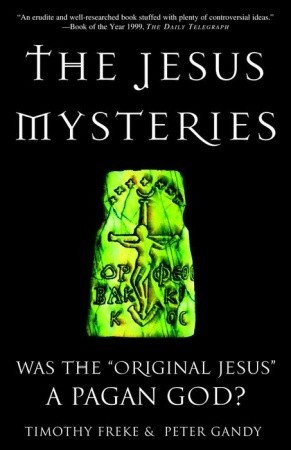
Source: The Jesus Mysteries: Was the “Original Jesus” a Pagan God? Chapter 1 – p.12-15 Timothy Freke and Peter Gandy

Random Notes On The Jesus Myth – Part One

last-supper-astrotheology

Connecting the dots concerning the fabricated “history” of Jesus has been eye opening to me. There’s overwhelming evidence the whole story of Jesus was invented by the political powers of Rome. Since so many people assume there was an historical Jesus, fear of the truth overcomes their reason, and they immediately defend their ego based false beliefs. I don’t want to convince anyone of what I’ve learned as the truth. My mother was indoctrinated into believing Jesus was a real person. I don’t want to kick her crutch out from under her. I have no reason to convince anyone who believes in Constantine’s cult that they are wrong. Their defenses range from childish to downright dangerous. Many immediately assume that if Jesus wasn’t real then there’s no God. Nothing could be further from the truth. The reason there have been so many god-man heroes based on Astrotheology is because mankind is obviously attracted to it. Even if in it’s ignorance (ignore-ance) mankind blindly follows the saga of the Sun, the planets and other signs in the cosmos as historical events taking place in history, it is the opposite of Spiritual. Myth is a way of teaching ever deeper meanings. An historical superman is a dead end. It’s blind faith (requires no critical thinking), it is ignorance that goes nowhere. The shock of learning that this story is untrue historically is a slap in the face of one’s completely brainwashed stupidity, and it’s not pleasant at first. But it does wake one up! But it’s not my job to awake anyone but myself. If a person finds comfort in a lie, who am I to interfere? I’m interested in truth no matter where it leads. I have found the truth will absolutely set us free, and also enlighten us in a way the church doesn’t want. They have their agenda and it has nothing to do with what’s in our best interest. The Gnostics were destroyed, but amazingly some of their writings have been found, and at a time in history where they wouldn’t be burned again. And I’m living in a time where I won’t be burned at the stake  for speaking the truth. The mystical side of various religions I find quite beautiful. The fundamental and literal part is 100% worthless hogwash. It’s embarrassing to me to be a part of such an ignorant and easily tricked group of zombie-like sheeple. If they use fake history to prove their point, they are fake people, living in a fake reality, and are as if already dead. The truth is hidden but can be discovered by anyone open minded enough to look for it. Yes, much of history has been altered for this myth, you do have to dig a bit. You cannot look up an early Church Father and quote them, because early pro-Christian quotes were interpolated centuries later. Hisorians have proven this. Hey, the built the town of Nazareth just to make the gospels literally true! They’ll stoop very low for this lie, because it is the lie upon which all other lies have been built upon. Rome lives on, trust me. Our laws and banks are made from Roman legalisms and Vatican maxims. They learned long ago to never inform or educate slaves.

“Osiris’s coming was announced by Three Wise Men: the three stars Mintaka, Anilam, and Alnitak in the belt of Orion, which point directly to Osiris’s star in the east, Sirius (Sothis), significator of his birth.”

Barbara Walker, The Woman’s Encyclopedia of Myths and Secrets (749)

“So this was the harbinger of the annual inundation of the Nile through her appearance with the rising sun at the time when the inundation was due to begin. The bright star would therefore naturally become, together with the conjoined constellation of Orion, the sign and symbol of new vegetation which the Year then beginning would infallibly bring with it.”

Dr. John Gwyn Griffiths, The Origins of Osiris and His Cult (157)

The three stars in the middle of the constellation form an asterism known as The Three Kings, or Orion’s Belt.

Dionysus: Born of a Virgin on December 25th, Killed and Resurrected after Three Days

The goddesses have stories to tell. One such story—far too long ignored—is that, in their original, unadulterated form, they were parthenogenetic. The word parthenogenesis comes from the Greek parthenos, ‘virgin’ more or less, and gignesthai, ‘to be born.’ It means, essentially, to be born of a virgin—that is, without the participation of a male. For a goddess to be ‘parthenogenetic’ thus means that she stands as a primordial creatrix, who requires no male partner to produce the cosmos, earth, life, matter and even other gods out of her own essence. Plentiful evidence shows that in their earliest cults, before they were subsumed under patriarchal pantheons as the wives, sisters and daughters of male gods, various female deities of the ancient Mediterranean world were indeed considered self-generating, virgin creatrixes.”

Dr. Marguerite Rigoglioso, Virgin Mother Goddesses of Antiquity (1)

“Let our Christian readers bear in mind that the worship of the virgin and her child was common in the East, ages before the generally received account of Christ’s appearance in the flesh.”

Existence of Christ Disproved

“Crishna was born of a chaste virgin, called Devaki, who, on account of her purity, was selected to become the ‘mother of God.'”

Doane, Bible Myths and Their Parallels in Other Religions

The Virgin Mary is called not only the Mother of God, but the Queen of Heaven. This connects her directly with astronomic lore. The ornamentation of many continental churches often includes a representation of the Sun and Moon “in conjunction,” the Moon being therein emblematical of the Virgin and Child.

As the Moon is the symbol of Mary, Queen of Heaven, so also a bright Star sometimes symbolizes him whose star was seen over Jerusalem by the Wise Men from the East.

Regarding the astrotheological nature of the gospel story, including the virgin birth/immaculate conception, the famous Christian theologian and saint Albertus Magnus, or Albert the Great, (1193?-1280) admitted:

“We know that the sign of the celestial Virgin did come to the horizon at the moment where we have fixed the birth of our Lord Jesus Christ. All the mysteries of the incarnation of our Saviour Christ; and all the circumstances of his marvellous life, from his conception to his ascension, are to be traced out in the constellations, and are figured in the stars.” – Hackwood

Again, the Christian virgin birth is no more historical or believable than that of these numerous other gods. Moreover, as Robertson says, “The idea of a Virgin-Mother-Goddess is practically universal.” The list of Pagan virgin mothers includes the following:

Alcmene, mother of Hercules who gave birth on December 25th

Alitta, Babylonian Madonna and Child

Anat, Syrian wife of “the earlier Supreme God El,” called “Virgin Goddess”

Cavillaca, Peruvian huaca (divine spirit) impregnated by the “son of the sun god” through eating his semen in the shape of a fruit

Chimalman, mother of Kukulcan

Chinese mother of Foe (Buddha)

Coatlicue, mother of the Mexican god Huitzilopochtli

Cybele, “Queen of Heaven and Mother of God”

Danae, mother of Perseus

Demeter/Ceres, “Holy Virgin” mother of Persephone/Kore and Dionysus

Devaki, mother of Krishna

Frigga, mother of the Scandinavian god Balder

Hera, mother of Zeus’s children

Hertha, Teutonic goddess

Isis, who gave birth to Horus on December 25th

Juno, mother of Mars/Ares, called “Matrona” and “Virginalis,” the Mother and Virgin

Mandana, mother of Cyrus/Koresh

Maya, mother of Buddha

Mother of Lao-kiun, “Chinese philosopher and teacher, born in 604 B.C.”

Mother of the Indian solar god Rudra

Nana, mother of Attis

Neith, mother of Osiris, who was “worshipped as the Holy Virgin, the Great Mother, yet an Immaculate Virgin.”

Nutria, mother of an Etruscan Son of God

Ostara, the German goddess

Rohini, mother of Indian “son of God”

Semele, mother of Dionysus/Bacchus, who was born on December 25th

Shin-Moo, Chinese Holy Mother

Siamese mother of Somonocodom (Buddha)

Sochiquetzal, mother of Quetzalcoatl

Vari, Polynesian “First Mother,” who created her children “by plucking pieces out of her sides.”

Venus, the “Virgo Coelestis” depicted as carrying a child

“Both Mithras and Christ were described variously as ‘the Way,’ ‘the Truth,’ ‘the Light,’ ‘the Life,’ ‘the Word,’ ‘the Son of God,’ ‘the Good Shepherd.’ The Christian litany to Jesus could easily be an allegorical litany to the sun-god. Mithras is often represented as carrying a lamb on his shoulders, just as Jesus is. Midnight services were found in both religions. The virgin mother…was easily merged with the virgin mother Mary. Petra, the sacred rock of Mithraism, became Peter, the foundation of the Christian Church.”

Gerald Berry, Religions of the World

“Mithra or Mitra is…worshipped as Itu (Mitra-Mitu-Itu) in every house of the Hindus in India. Itu (derivative of Mitu or Mitra) is considered as the Vegetation-deity. This Mithra or Mitra (Sun-God) is believed to be a Mediator between God and man, between the Sky and the Earth. It is said that Mithra or [the] Sun took birth in the Cave on December 25th. It is also the belief of the Christian world that Mithra or the Sun-God was born of [a] Virgin. He travelled far and wide. He has twelve satellites, which are taken as the Sun’s disciples…. [The Sun’s] great festivals are observed in the Winter Solstice and the Vernal Equinox—Christmas and Easter. His symbol is the Lamb….”

Swami Prajnanananda, Christ the Saviour and Christ Myth

Mithra has the following in common with the Jesus character:

Mithra was born on December 25th of the virgin Anahita.

The babe was wrapped in swaddling clothes, placed in a manger and attended by shepherds.

He was considered a great traveling teacher and master.

He had 12 companions or “disciples.”

He performed miracles.

As the “great bull of the Sun,” Mithra sacrificed himself for world peace.

He ascended to heaven.

Mithra was viewed as the Good Shepherd, the “Way, the Truth and the Light,” the Redeemer, the Savior, the Messiah.

Mithra is omniscient, as he “hears all, sees all, knows all: none can deceive him.”

He was identified with both the Lion and the Lamb.

His sacred day was Sunday, “the Lord’s Day,” hundreds of years before the appearance of Christ.

His religion had a eucharist or “Lord’s Supper.”

Mithra “sets his marks on the foreheads of his soldiers.”

Mithraism emphasized baptism.

“In the ancient world there was a very widespread belief in the sufferings and deaths of gods as being beneficial to man. Adonis, Attis, Dionysos, Herakles, Mithra, Osiris, and other deities, were all saviour-gods whose deaths were regarded as sacrifices made on behalf of mankind; and it is to be noticed that in almost every case there is clear evidence that the god sacrificed himself to himself.”

Sir Arthur Weigall, The Paganism in Our Christianity

“Osiris…was successively god of the Nile, a life-giver, a sun-god, god of justice and love, and finally a resurrected god who ruled in the afterlife…. The most popular legend about Osiris is one of a resurrected god. He was killed by Set, the god of darkness… Osiris was then resurrected and went to live on high. Osiris became the first of a long line of resurrected deities—Tammuz, Mithras, Balder, Christ. Every spring the life of Osiris was re-enacted at Abydos in a stirring passion play, dating back to the eighteenth or nineteenth century before Christ. This play is the earliest record in history of drama.”

Gerald L. Berry, Religions of the World

“Osiris or the sun was now worshipped throughout the whole world, though under different names. He was the Mithra of the Persians, the Brahma of India, the Baal or Adonis of the Phoenicians, the Apollo of the Greeks, the Odin Of Scandinavia, the Hu of the Britons, and the Baiwe of the Laplanders.”

W. Winwood Reade, The Veil of Isis; Or, Mysteries of the Druids

Immortality as Consciousness

movamulet

As portions of the One, we are immortal. We have chosen to ‘play’ in space-time, the earth plane of Limitation. Caught in temporal mortal forms, our human body, veiled in the illusion of separation and Samsara, the cyclical ocean of death & birth, we fear our impending inevitable death.

While enjoying the adventure of Limitation, human beings since ancient times have fervently sought immortality. From the Akkadian Gilgamesh to the alchemist Sir Isaac Newton, eternal life has been the burning desire of many, especially the rich and powerful. Throughout our current Kali Yuga, all of written history, men and women have longed for immortality in the hope of prolonging their present identity and perhaps even bodily form. Yet most remain deluded — bound in our self-imposed sojourn.

There are now 176 billion observable galaxies. There are trillions of stars, each of which in all probability may have at lease one inhabitable planet awaiting life forms. There is no reason to assume that the numerous extra terrestrial races have no part in the seeding and colonization of planets. Indeed the idea that earth was seeded by various off-planet beings is not in conflict with the metaphysical traditions of consciousness and enlightenment found in the Sanskrit texts.

Ritual as Control

It appears that on occasion, the beings that colonized planet Earth, their priests and occultists, have offered their ‘chosen’ ones elaborate rituals, tests and quests that promised immortality. These chosen ones participated in elaborate, often costly and sacrificial rituals only to find themselves after death in yet another temporal realm – a slice of the myriad realms, the temporal astral planes, which they magnetized by the ritual practices. All these realms, every layer of 1000′s of heavens, hells and in-between are temporal, limited by time. Thus the ‘chosen’ who thought they were achieving immortality, found themselves eventually back in Samsara, the endless cycles of death & birth. They had not reached true immortality, the eternal imperishable One that pervades All — that which they were to begin with!

The idea that man could make himself immortal beyond time, through time-based priestcraft rituals and so-called ‘sacred’ material objects as instruments is a bit humorous. Everything is sacred. Immortality is not about life span, years in any particular bodily form, sharira. Real immortality is reaching God Consciousness, returning to our Source, That, the Tattva-ness we have always been. Therefore any and all elaborate secret arcane occult ritual dramas only got the’chosen’ ones to yet another temporal realm.

The Chandogya Upanishad III.6 explains the Real immortality, amritam, which is beyond the hands of time. The Seer Rishis reached immortality by ‘brooding’ on the verses in the Rig Veda, meaning they focused on the Wisdom Truth in the Sanskrit verses which are compared to the flowers of immortal nectar, a honey water that has the power to issue forth in its essence the birthless-deathless Reality. The wisdom woven in the verses holds the ineluctable power to immerse, absorb and return our consciousness into the One, the Source eternal beyond death and birth.

Our colonizers did indeed have much longer life spans than we earthlings. The Anunnaki were not the first of these colonizing races, but perhaps they were the last. One year for Anu, Enlil, Enki, Ninhursag, Inanna and the others is said to be 3600 of our human years. In terms of their years, they have not been ‘absent’ from our planet for very long. However they too die, even though we could not perceive their mortality because their allotted years greatly exceeded ours.

The Bhagavad Gita states that all manifest beings are mortal. In XVIII.40 Krishna says that no being, either on earth or in heaven among the ‘gods’ is free of Prakriti’s gunas, meaning the modes of material nature, the matrix that exists in time. Even the spheres of the Vedas, their rites and rituals, are said to be confined to the three gunas (sattva, rajas & tamas) and therefore belong to the plane of time. Krishna [BhG.II.45] urges his friend Arjuna to Become, to move beyond duality and liberate himself from the gunas, the power Shakti of Prakriti’s matrix.

Time Relative to the Vital Rhythms

Alain Danielou has a very insightful take on immortality in his book ‘While the Gods Play.’ He says that even though the duration of the gods may appear immense to our human consciousness, they are still “within the domain of multiplicity, the domain of Prakriti” and thus are mortal. How could these gods give us immortality when they do not themselves possess it?

Danielou states that the relative experience of time by various forms in creation is due to “the value that we attach to a given length of time…relative to our physical body. It is determined by the vital rhythms of each species.” Each life form has its own heartbeat and this vital rhythm dictates its duration in time.

Even though the immortality of the flesh is unobtainable, what was given to us is the sacred Wisdom-Knowledge to reach our own God-Consciousness that dwells within each of us. This knowledge was revealed and concealed in the Rig Veda. The Upanishads were written many years later and sought to illuminate the Rig Veda. “The Upanishads form a natural continuity of the glorious spiritual visions and realizations reached by the Rishis of the [Rig Veda] Samhitas… [T.V. Kapali Sastry].” The consciousness of mankind was continually ineluctably sinking into the solidification of matter through an increasing differentiated five-sense perception, as the Kali Yuga inexorably rolled on into ever-deeper density.

The colonizers of planet Earth were taken to be gods because they possessed advanced technology and seemed immortal to us. The term ‘gods’ in Sanskrit devas comes from the root √div and simply means shinning, luminescence, effulgence. The devas are the invisible (to the five senses) forces which play their part in the subtle body to generate the creative give-and-take relationship with the manifest external, the temporal illusory holographic universe. “The gods of the Vedic pantheon – Agni, Vayu, Indra, Surya – are frequently mentioned as having a double function as nature powers in the universe, (adhidaivatam), and as lords of the sense, life, mind and other instruments of the soul within us, (adhyatmam). [T.V. Kapali Sastry]”

Dead Ritual

The ‘gods’ have been personified throughout written history and tyrants have used this tool of the personification of ‘gods’ and the mythopoeisation of history [Malati J. Shendge] to control us through fear. Tyrants benefit from fear and endless destructive wars, many of which have been religious. Ritual has played its role and I quite like this description of the birth of ritual by the Sanskrit scholar, Malati J. Shendge — any ritual, yours and mine: “When the events became symbolic and were ascribed magical powers to attain certain aims, the process of mythopoeisation was complete. History was forgotten and dead ritual became the end in itself.”

Many of the Upanishads reject ritual. Swami Muni Narayana Prasad says that the Mundaka Upanishad “highlights the defects and weak points of Vedism and its ritual, and advises the seeker to become indifferent to them.” In the Bhagavad Gita II.45-6 Krishna says that Vedic rituals belong to the domain of Prakriti’s three gunas and tells Arjuna to ‘Become!’ without them; and further, he says that the Vedas are of no more use to the Self-Realized person than a well, when the entire land is flooded. Priestcraft rituals will not deliver immortality or Moksha, Liberation.

Sanskrit is a very difficult language to learn, and is said to take eighteen years to master all the subtleties of Sanskrit grammar. Naturally this arduous task left Sanskrit and therefore knowledge in the sacred Sanskrit texts, under the control of an elite. In India a guru was the only means to access the knowledge of the Vedas, Upanishads, etc. because unless you were born into the priest caste, you could not read the texts. Thanks to the many translations of these jewels of wisdom, people all over the world can now read the ancient sacred Sanskrit texts. Some of the translations are surely superior to others, just as there are good gurus and better ones. A translation made by an enlightened master is going to carry the power of that consciousness, and therefore be a more direct revelation.

With a sincere heart and dedicated purpose, I believe that we don’t necessarily require a guru. Certainly an enlightened teacher would be a wonderful experience, but even the Kashmir Shaivite saint and scholar, Swami Lakshmanjoo has said, “Don’t pin this on me!” In the last moments, it is up to us. As Krishna says [BhG.VI.5], we must lift ourselves up by the Self, Atmana. Swami Muni Narayana Prasad has also said that some do reach enlightenment by their own efforts, alone and without a guru.

Wisdom from Altair

In my book ‘Inanna Returns’ based on my visions of the Anunnaki colonization of our planet Earth, Inanna told me that when the geneticists Enki and Ninhursag created us, the lulus, they intentionally unplugged some of the genes. These genes in the human body were connected to our ability to realize that we are the One. The colonizing family did not want a worker race that refused to take orders or might rebel. Our ignorance of our origins served their purpose and kept us in the bow-down-and-worship phase of our evolution. I assumed that this was natural because the radiation wars seemed to coincide with the advent of the Kali Yuga — and thus the exposure to radiation pushed the human race into deeper ignorance and limitation.

Inanna said that when she was given the Indus Valley, she was already quite fed up with the increasingly chauvinistic attitudes of the males in her family and thus she resolved to attempt to activate the unplugged DNA. If you think of how many metaphysical systems there are in India, just imagine that throughout the universe there must be countless versions of primordial metaphysics, Truth, Satya, Rita (from the root meaning to rise, tend upward), the Eternal Right, Sanatana Dharma. Inanna called the system Samkhya, and because I did not want to add more to ET confusion, I said it originated in the Pleiades; but Inanna told me that what she taught was from Altair. Ninhursag’s mother came from the Altairian system and Ninhursag in turn, taught Inanna. Setting up what amounted to Tantric temples that practiced tantric rituals with trained priestesses and priests, Inanna determined to give the humans, the lulus, an advantage in consciousness.

‘God’ Genes

The immediate offspring of the Anunnaki already had better DNA, meaning they had abilities to access other dimensional realms that most of the worker race did not possess. When Enlil found out that Inanna was doing this, he was horrified, angry, and gave Marduk permission to destroy the Indus Valley civilization.

I don’t ask the reader to believe what I say here about the Indus Valley Civilization, but look at India – how amazing is it that the ancient Sanskrit texts were preserved. How incredible is it that the British thought that India’s ancient religious beliefs were not worth destroying. Remember that the Romans burned the ancient books in the Library of Alexander. I know — I died in that fire. Sometimes when I am copying a Sanskrit verse, I see the letters through the eyes of that lonely old man in the library at Alexandria, slowly methodically copying old Sanskrit written on dried palm leaves.

It is a miracle that we do have the Rig Veda, the Upanishads and the Bhagavad Gita, the essence of them all, to guide us Home.

Think of how often tyrannical dark forces have destroyed great civilizations, devastating the earth again and again, leaving the vast majority of mankind in poverty, fear, hunger, and ignorance. Wouldn’t our acceptance of wisdom teachings allow more to become enlightened? Who doesn’t want us to remember that we are portions of the One? Surely if everyone is God, then it can only be that there are designated beings whose ‘job’ description is playing the Darth Vader roles. In the Mahabharata, the character Duryodhana, who has played a primary part in starting the war, in fact is upon his death greeted with cheers and showers of flower petals by the ‘gods’ in the heavens. He is said to enjoy a heaven for those who have played their role, meaning he has lived out his own dharma and contributed to the adventure of limitation, the human drama.

I know this may sound a bit crazy at first, but consider this — if we all became enlightened at once, would the universe collapse? Who would there be to ‘play’ and mirror the myriad aspects of the One into the temporal illusory hologram? Yes, the bad guys do have a role, and this included the Anunnaki. Some of the family are in fact now trying to help us and many have incarnated in human flesh-and-blood bodies to activate the dormant genome. The hope is to re-establish the Satya Yuga, the era of Truth, and our collective memory of primordial metaphysics, without which there can be no harmony with the Creator, but only further delusion and dissolution.

Fear Propaganda as Control

The cacophony of a threat-matrix around the Anunnaki coming is just one more in a long line of ritual-rackets from the Fear Inc. tyrants who seek to keep mankind bewildered, confused, in fear and safely away from the Wisdom-Knowledge of our true Being, the One. Instead of rapid-fire running around the Internet, chasing mendacity and demons, and messing up the synaptic patterns in our brain that are conducive to contemplation, let us focus on our own consciousness within. There we will find Peace, lasting Love, integrity, truly useful power, and even our own Immortality.

For thousands of years the Sanskrit texts have held the secret key to our freedom and enlightenment, the recognition of our innate God-Consciousness within. That is the only immortality we have ever needed. The rest is mere delusion and deception. Just as the only real Free Will we possess is latent within us, so it is that true immortality awaits us within, in the Heart.

I often say to myself and I hope you have a sense of humour, because I mean this in the highest most sacred loving sense — I often say that God is crazy! God is crazy in Love for Its Creation. There is only one Soul, forever dancing in crazy Love, Its mad blissful Joy across thousands of universes.

We meet in the Heart,

V. Susan Ferguson

“The gods of the Vedic pantheon – Agni, Vayu, Indra, Surya – are frequently mentioned as having a double function as nature powers in the universe, (adhidaivatam), and as lords of the sense, life, mind and other instruments of the soul within us, (adhyatmam). [T.V. Kapali Sastry]”

About the Author

V. Susan Ferguson is the author of Inanna Returns, Inanna Hyper-Luminal; her own commentary on the Bhagavad Gita and the Shiva Sutras; and Colony Earth & the Rig Veda. Her website is Metaphysical Musing.

“The gods of the Vedic pantheon – Agni, Vayu, Indra, Surya – are frequently mentioned as having a double function as nature powers in the universe, (adhidaivatam), and as lords of the sense, life, mind and other instruments of the soul within us, (adhyatmam). [T.V. Kapali Sastry]”

Brihadaranyaka Upanishad, I.iv.10:

“And to this day, [those] who…know the Self as I am Brahman [the One], become all this universe.
Even the gods [any other dimensional beings] cannot prevent his becoming this, for he has become their Self. …if a man worships another deity thinking: He is one and I am another, he  does not know.
He [who does not know] is like a sacrificial animal to the gods. As many animals serve a man, so does each man serve the gods. Even if one animal is taken away, it causes anguish to the owner; how much more so when many are taken away!
Therefore it is not pleasing to the gods that men should know this [that they are the One].”

Resources: 

– Lights on the Upanishads, with Sri Aurobindo Darshana, by T.V. Kapali Sastry; Sri Aurobindo Kapali Sastry Institute of Vedic Culture, Bangalore, 1947, 2004.

– While the Gods Play, Shaiva Oracles and Predictions on the Cycles of History and the Destiny of Mankind, by Alain Danielou; Inner Traditions International, Rochester, Vermont, 1987.

– Bhagavad Gita, In the Light of Kashmir Shaivism, with original video, Revealed by Swami Lakshmanjoo, Edited by John Hughes, Co-editors Viresh Hughes and Denise Hughes; Universal Shaiva Fellowship, 2013.

– Life’s Pilgrimage Through The Gita, by Swami Muni Narayana Prasad; D.K. Printworld, New Delhi, 2005, 2008.

– The Bhagavad Gita in the Mahabharata, A Bilingual Edition, translated by J.A.B. van Buitenen; The University of Chicago Press, 1981.

– The Bhagavad Gita, translated by Winthrop Sargeant; State University of New York Press, 1994.

– Abhinavagupta’s Commentary on the Bhagavad Gita, Gitartha Samgraha, translated by Boris Marjanovic; Indica Books, Varanasi, 2002, 2004.

– The Civilized Demons: The Harappans in Rig Veda, Malati J. Shendge; Abhinav Publications, New Delhi, 1977.

– Satyaloka in the Rig Veda, A Study, by Dr. A. Venkatasubbiah (1886-1969); Vishveshvaranand Vedic Research Institute, 1974.

This article is offered under Creative Commons license. It’s okay to republish it anywhere as long as attribution bio is included and all links remain intact.

Santos Bonacci – Reclaiming Dominion

Indeed watching these two videos is quite time consuming, but you will walk away with a new understanding of religion, Rome’s Christian Cult, the Law and how evil conspires to keep us from rediscovering our Divine Nature. We can easily reclaim our Dominion, just start by declaring it after being informed to how you were tricked into slavery. You can view Black’s Law Dictionary online to get an idea how Legal jargon is trickery, words mean something completely different, and this has tricked us into slavery. Santos explains the Holy Science of Astrotheology and much more. I hope others will at least find the time to watch one of these important and mind opening videos. (Santos Bonacci was recently arrested (kidnapped by the cops illegally). He is out of jail and I’m following this saga the best I can. I think it would be good to show support for Santos by joining his Facebook page (and/or  that of his wife Sonia Bonacci),  subscribing to his youtube channel and his website http://universaltruthschool.com/  ). A quick search of Santos Bonacci will result in slander by frightened members of the Christian Cult trying to debunk Santos. It reads more like gossip, hate and made up heresy, you know, what Christians do when confronted with reality. Santos can take it, though it’s highly unfair and always show up in the first search results. That’s deliberate mind control. The sheep policing the sheep. What a racket! Prepare for some eye opening and mind altering Gnosis!!

via Santos Bonacci – Reclaiming Dominion Part One – YouTube.

▶ The Art of Deception Official Full Movie

“It is impossible for a man to learn what he thinks he already knows.”
Epictetus

Over the past decade, the documentary genre has become a bad joke. Fact is no longer a factor. As technology has developed, sights like youtube and vimeo make it possible for anyone to broadcast information, even if the information they express is based on lies. In an academic environment, a paper must have detailed references according to a set of university standards, but in a film, anything goes. The Art of Deception is an explanation of how a documentary is constructed to communicate truth, brainwash the audience and push an agenda.

The Art of Deception explains the way the media has become a puppet for certain people. For example, Al gore used his documentary ‘An Inconvenient Truth’, as a puppet to persuade people that climate change is a real problem. The convenience of Gore’s investments is where the truth really lies, and not in his movie (Which is banned in UK schools because of its blatant lies and disrespect for science).

The US government used Kony 2012, or the invisible children, as a puppet to invade Uganda after they discovered huge amounts of untapped oil. This is explained in great detail in the documentary.

How can we ever KNOW if what we think we know is really a fact? How can we prevent being manipulated into believing lies? Why is there a need to lie and keep secret certain things about science, politics, religion, history etc? Do we live on the Devil’s playground? Everyone is entitled to their own opinion, but not their own facts! Opinions based on lies aren’t worth much, are they? Or perhaps they are … to someone. How important is it to YOU to know what’s true and what’s not?

“The mark of a stupid man is not that he does not know,
it is that he chooses not to know!”

  • 9 Truths You Should Know by Now

    “In school, you’re taught a lesson and then given a test. In life, you’re given a test that teaches you a lesson.” ~  Tom Bodett

    Life has a very interesting way of teaching us many of the many things we need to learn, don’t you think? It seems to me that the more we hold on to this idea of how life should be, how events should unfold, how people should treat us and how happiness should be packaged and delivered to us, the more we suffer. Happiness is nothing more than a balance between holding on and letting go but this is a different story.

    What I will share with you today are 9 simple yet powerful truths we learn as we go through this beautiful journey called life.

    1. Life is a process of becoming.

    We go through life to find ourselves, to become ourselves.

    Don’t be afraid to make “mistakes”. Don’t be afraid to “fail”. Have fun in all that you do. The more things you do in life, the more things you’ll learn from life.  Enjoy the journey because that’s what life is all about. It’s not about rushing towards a final destination, its about enjoying the journey…

    “When you meet anyone, remember it is a holy encounter. As you see him you will see yourself. As you treat him you will treat yourself. As you think of him you will think of yourself. Never forget this, for in him you will find yourself or lose yourself. ” ~ Helen Shucman

    2. You are exactly where you need to be.

    If you’re in a really dark place right now, chances are that you’ll not be too pleased to know this, but the truth of the matter is that

    “Life will give you whatever experience is most helpful for the evolution of your consciousness. How do you know this is the experience you need? Because this is the experience you are having at the moment.” ― Eckhart Tolle

    You can either choose to accept or resist what is, and based on your choice you will find the clarity and the strength to move forward in life, or stay stuck. It’s all up to you. The power is in your hands.

    3. Let Go of Fear. Love is all you need.

    May sound like a cliche, but the truth of the matter is that LOVE is all you need. Love is the only thing that’s real, the only thing that matters. By closing the door to your heart and by building walls between you and the whole world, you won’t keep suffering away from your life, you will keep it in your life!

    Can’t you see?

    It’s that closed door and those fearful walls that are causing you to experience all that pain. Open the door to your heart. Let go of fear. Tear down the walls you have built and allow trust, light and love to govern your heart.

    “Fear condemns and love forgives. Forgiveness thus undoes what fear has produced.” ~ A Course in Miracles

    4. Forget about your age.

    Who cares how young or old you are? It’s not your age that’s standing between you and all the wonderful thing you long for, it’s you! Your thoughts, your beliefs, your excuses and your self imposed limitations are the ones that keep you from acting on your heart’s desire. Age has nothing to do with it. If you inner fire is still burning and if you’re really passionate about crafting the life of your dreams, worrying about your age will be the last thing on your mind.

    “Age is an issue of mind over matter. If you don’t mind, it doesn’t matter.” ~ Mark Twain

    5. Life will give you whatever you ask for.

    Life is good with those who think they deserve to receive good things, and “bad” with those who think they deserve to receive “bad things. Life gives you whatever you ask of it. It doesn’t discriminate.

    If you want to receive great things from life, you have to ask for them, but not only that. You also have to feel worthy of receiving them, and you have to be willing to take the necessary steps that will help you achieve the things you want to achieve. None of the things you want will just fall into your lap – you’ve got to go out and work for them.

    “I bargained with Life for a penny, and Life would pay no more, however I begged at evening when I counted my scanty store. . ‘For Life is a just employer, he gives you what you ask, but once you have set the wages, why, you must bear the task. ‘I worked for a menial’s hire, only to learn dismayed, that any wage I had asked of Life, Life would have willingly paid.” ~ My Wage by Jessie B. Rittenhouse

    6. Life isn’t as bad as you THINK it is.

    We all have crazy thoughts running through our heads but that doesn’t mean we have to believe everything we think. Whenever a negative and toxic thought runs through your mind, replace it with a positive one. That’s how it’s done. That’s how you go from negative to positive thinking. One step at a time, one thought at a time.

    “Thoughts are like an open ocean, they can either move you forward within its waves, or sink you under deep into its abyss.” ~ Anthony Liccione

    7. It’s not them, it’s You.

    The world is not against you, it really isn’t. It’s not the world that’s against you, it’s you that’s against the world and by rebelling against the world you are in fact rebelling against yourself.  Make peace with yourself and the whole world will make peace with you.

    “Nothing external to you has any power over you.” ~ Ralph Waldo Emerson

    8. Your future will be exactly like the way you feel today.

    What does this mean? it means that if you are constantly criticizing and complaining about everything and everyone, pointing fingers and expecting the whole world to change just so you can finally be happy, your future will be an identical copy of your present reality. It’s not the world that needs to change so that you can finally be happy, it is you. Nothing changes until you do…

    “Everyone thinks of changing the world, but no one thinks of changing himself.” ~ Leo Tolstoy

    9. None of this will matter in the end

    Do you really think that the things you are now stressing and worrying about will even matter one year from now? I doubt that. Let go of stress. Laugh in the face of chaos. None of it will matter in the end.

    Your life has an expiration date and so does mine. None of us is going to live forever. Stress less, live more. Detach from all the drama that your mind is constantly trying to create. Focus on the things that truly matter and start laying the foundation to the wonderful life you say you want to live. You’re not going to live forever. If you don’t start living your life fully now, chances are that you never will…

    “People wait all week for Friday, all year for Summer, and all life for Happiness…” ~ Ritu Ghatourey.

    Get unstuck and get going. I will be cheering for you all the way.

    With all my love, Luminita Saviuc, Purpose Fairy

    via 9 Truths You Should Know by Now – Waking Times.